

When I started in banking in the early 1990s, a portfolio review meant a quarterly meeting with a relationship manager, a printed statement, and a conversation that rarely strayed beyond the standard asset allocation models his firm had approved. The advisor’s value was partly expertise, partly access to markets you could not reach alone, and partly the relationship itself.
In 2026, that picture has changed more than most people in the industry want to admit. What does an AI financial advisor in 2026 actually look like? These platforms now manage over $1.8 trillion in US assets and have evolved far beyond the simple robo-rebalancers of 2015. Tax-loss harvesting, retirement income projection, multi-goal optimization, real-time portfolio adjustment – these are now standard features at 0.25% per year or less.
The question is no longer whether an AI financial advisor in 2026 can manage a portfolio. It clearly can. The question is when it should – and when it should not.
Welcome to Didi Somm & Team
Disclaimer: This article is for educational purposes only and is not financial or investment advice. Fee figures reflect publicly available information as of 2026. Always verify current rates directly with providers before making decisions.
KEY TAKEAWAYS
- Robo-advisors now manage over $1.8 trillion in US assets — the category has gone mainstream, not niche
- The fee gap between a robo-advisor (0.25–0.50%) and a human advisor (1.0–1.5%) costs $470,000 over 20 years on a $500,000 portfolio
- AI advisors in 2026 handle tax-loss harvesting, retirement income planning, and multi-goal optimization – far beyond simple rebalancing
- Human advisors are not being replaced – they are being freed from grunt work to focus on complex planning and behavioral coaching
- The hybrid model (automated portfolio + human access for big decisions) is the default intelligent choice for most investors in 2026
Table of Contents
What AI financial advisors can actually do in 2026
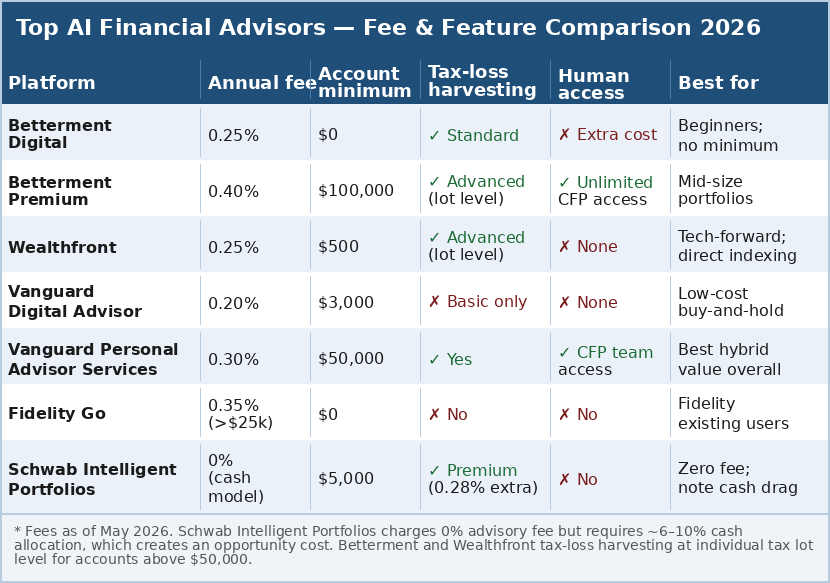
The term “AI financial advisor” covers a wide range. At one end are the established robo-advisors – Betterment, Wealthfront, Vanguard Digital Advisor, Fidelity Go, Schwab Intelligent Portfolios – which use rules-based automation to manage diversified portfolios at low cost. At the other end are newer AI-powered planning assistants that use large language models to have genuine conversations about your financial situation and generate personalized advice.
In 2026, the major robo-advisor platforms have meaningfully extended their capabilities. Betterment’s AI planning assistant now handles multi-goal optimization simultaneously – balancing retirement savings, a house down payment, and college funding in a single model. Wealthfront offers direct indexing for accounts over $100,000, holding individual stocks instead of ETFs to maximize tax-loss harvesting at the individual tax lot level. Vanguard Digital Advisor charges 0.20% and combines AI-driven allocation with access to human advisors at 0.30% for its hybrid tier.
The 2024–2025 robo-advisor performance data is instructive: most platforms returned 12–15% in 2024 (a strong equity year) and delivered positive returns in the more volatile 2025 environment, broadly in line with equivalent benchmark portfolios. The platforms are not generating alpha – they are capturing market returns at minimal cost, which for most investors is exactly the right goal.
The fee gap: the number that changes everything
The central financial argument for AI advisors is the fee comparison. A typical human financial advisor charges 1.0–1.5% of assets under management annually. A typical robo-advisor charges 0.25–0.50%. On a $500,000 portfolio over 20 years, that difference -assuming 7% annual returns before fees – amounts to approximately $470,000 in additional wealth for the lower-fee investor. That is not a rounding error. It is a meaningful portion of a retirement.
The counter-argument from the human advisory industry has shifted. Ten years ago, advisors argued that their active management justified the fee premium. Today, with overwhelming evidence that most active management underperforms passive alternatives after fees, that argument is largely abandoned. The modern case for human advisors rests instead on three genuinely defensible claims: behavioral coaching during market volatility, coordination of complex tax and estate situations, and accountability for major life decisions.
From my years in banking, I can confirm that the behavioral coaching argument is real. The most expensive mistake I watched clients make repeatedly was selling at market bottoms – not because they lacked information, but because they panicked. A trusted human relationship provides something an algorithm cannot easily replicate: a calm voice at 3 a.m. when markets are collapsing, and the instinct to act feels overwhelming.
What an AI financial advisor in 2026 still cannot do well
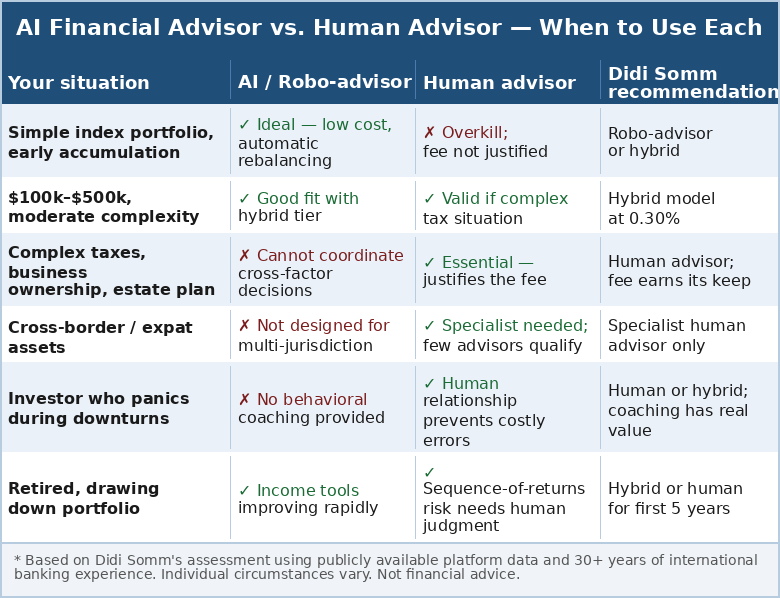
Tax and estate coordination for complex situations remains the clearest human advantage. An AI financial advisor in 2026 can identify tax-loss harvesting opportunities within your portfolio. It cannot coordinate those decisions with your business interests, your spouse’s income, your estate plan, your offshore accounts, or the specific provisions of a trust your attorney drafted. For investors with genuinely complex situations – significant taxable gains, inherited assets, cross-border exposure, business ownership – the interaction effects between financial decisions are too nuanced for current AI platforms.
Behavioral coaching at genuine inflection points is the second defensible advantage. When a client is considering liquidating their portfolio during a crisis, selling their business at the wrong time, or making a major decision driven by fear or grief, the value of a trusted human relationship is difficult to quantify and hard to replace algorithmically.
Accountability is the third. An AI platform won’t call you when you haven’t reviewed your plan in two years. A good human advisor does. For investors who need external accountability to stay disciplined, the relationship has value beyond the advice itself.
The hybrid model: what most investors should use in 2026
The most intelligent answer for most investors in 2026 is not a binary choice. The hybrid model – automated portfolio management combined with periodic access to a human planner for significant decisions – is the default intelligent choice and is now widely available.
Vanguard Personal Advisor Services at 0.30% provides automated portfolio management plus access to certified financial planners. Betterment Premium at $100,000 minimum provides the same structure. For investors in the $100,000 to $500,000 range with moderate complexity, this hybrid approach offers an excellent balance of low ongoing cost and human expertise when it actually matters.
My own approach, for what it is worth: I use automated tools for routine portfolio management and monitoring. I bring in human expertise for tax planning, cross-border considerations, and any decision where multiple factors make the outcome genuinely uncertain. AI handles execution and monitoring. I reserve the human relationship for moments when judgment, not optimization, is needed.
FAQs – AI Financial Advisor in 2026
What is an AI financial advisor in 2026?
An AI financial advisor is a software platform that uses algorithms or artificial intelligence to manage investment portfolios, provide financial planning guidance, or both. The category ranges from rules-based robo-advisors like Betterment and Wealthfront to AI-powered planning assistants that generate personalized financial advice through natural language conversation.
How much do AI financial advisors cost in 2026?
Most robo-advisors charge between 0.20% and 0.50% of assets under management annually. Fidelity Go charges 0.35% for accounts over $25,000. Vanguard Digital Advisor charges 0.20%. Betterment charges 0.25%. Hybrid models with human access typically charge 0.30–0.40%.
Can an AI financial advisor replace a human financial advisor?
For most investors with straightforward situations – primarily index fund portfolios, standard asset allocation, no complex tax or estate issues – yes. For investors with complex situations involving business ownership, cross-border assets, estate planning, or significant behavioral coaching needs, a human advisor remains irreplaceable.
How much can I save by using a robo-advisor instead of a human advisor?
On a $500,000 portfolio over 20 years, the difference between a 0.30% robo-advisor fee and a 1.50% human advisor fee amounts to approximately $470,000 in additional wealth, assuming 7% annual returns before fees.
Which AI financial advisor in 2026 is best?
Betterment and Wealthfront are the most feature-rich pure robo-advisors. Fidelity Go and Vanguard Digital Advisor are the best options for investors already at those brokerages. For hybrid models with human access, Vanguard Personal Advisor Services at 0.30% is the strongest value proposition for most investors.
Do AI financial advisors perform as well as human advisors?
For standard diversified portfolios, robo-advisors broadly match equivalent benchmark returns after fees – and significantly outperform most actively managed human-advised portfolios after the fee differential is applied. AI platforms do not generate alpha; they efficiently capture market returns at minimal cost.
What does an AI financial advisor in 2026 do that a basic index fund does not?
Automatic rebalancing, tax-loss harvesting, goal-based planning, retirement income projection, and multi-goal optimization. These features add meaningful value compared to simply buying and holding a single index fund without any ongoing management.
Is my money safe with a robo-advisor?
Yes. All major robo-advisors are registered investment advisors regulated by the SEC. Your assets are held in your name at a custodian bank and are SIPC-insured up to $500,000. They are not a bank – your funds are not at risk from the platform’s own financial health.
What is the hybrid model and is it right for me?
A hybrid model combines automated portfolio management (low cost, always-on) with access to human financial planners for periodic reviews and major decisions. It is the default intelligent choice for most investors in the $100,000 to $500,000 range with moderate financial complexity.
Will AI completely replace financial advisors in the future?
AI will absorb the routine portfolio management and rebalancing layer – that is already largely complete. The defensible human value – behavioral coaching during volatility, estate and tax coordination, accountability, and relationship – is harder to automate and likely to persist for the foreseeable future.
How do I know if I need a human advisor or a robo-advisor?
Use a robo-advisor if your situation is straightforward – index fund portfolio, standard retirement savings, no complex tax or estate issues, and you are a disciplined investor who will not panic during downturns. Consider a human advisor or hybrid if you have complex tax situations, significant wealth, cross-border assets, estate planning needs, or know from experience that you need someone to hold you accountable.
What happened to robo-advisor returns in 2024 and 2025?
Most major platforms returned 12–15% in 2024 in line with strong equity markets, and delivered positive returns in the more volatile 2025 environment, broadly tracking equivalent benchmark portfolios. The platforms are not designed to beat the market – they are designed to capture market returns efficiently.
Conclusion
AI financial advisors in 2026 are genuinely good at what they do – and what they do covers the needs of a significant majority of investors. For straightforward portfolios, early accumulation phases, and investors who are disciplined and don’t need behavioral coaching, the fee savings from a robo-advisor or hybrid platform are compelling and hard to justify passing up. For complex situations, significant wealth, or investors who know they need human accountability, the human relationship still earns its fee. The honest answer to whether an AI financial advisor can replace your $5,000-a-year planner is: for many people, yes – and the math strongly suggests they should make the switch.
Good luck with your future investments!
Didi Somm & Team
Recently published articles include:
- First Job 401k Advice: The 5 Top Moves Every 22-Year-Old Should Make
- US Expat Investing Mistakes: The Top 7 That Cost $50,000 or More
- Mega Backdoor Roth 2026: The $70,000 Loophole Most People Miss
- Fidelity vs Schwab vs Vanguard 2026: Honest Cost Breakdown
- ChatGPT Portfolio Management: 30 Days, 5 Tests, 2 Failures
- 401k Contribution Limits 2026: The Complete Optimization Guide
- BACKDOOR ROTH IRA – All You Need To Know in 2026
- Roth IRA Guide: Your Roadmap to Tax-Free Retirement Wealth
About the author
Didi Somm spent 30+ years in international banking with Credit Suisse and UBS. He also runs dorealadvice.com, a business-intelligence platform. He writes here about building wealth with clarity and discipline.
Disclaimer: This article is for educational purposes only and is not financial or investment advice. Fee figures reflect publicly available information as of 2026. Always verify current rates directly with providers before making decisions.