

I spent the better part of three decades in international banking, and in time, I watched many smart, financially literate American colleagues make the same expensive mistakes with their investments abroad – not because they were careless, but because the US tax and regulatory framework for expats is genuinely unusual, and most financial advisors in the countries where Americans live do not know it exists.
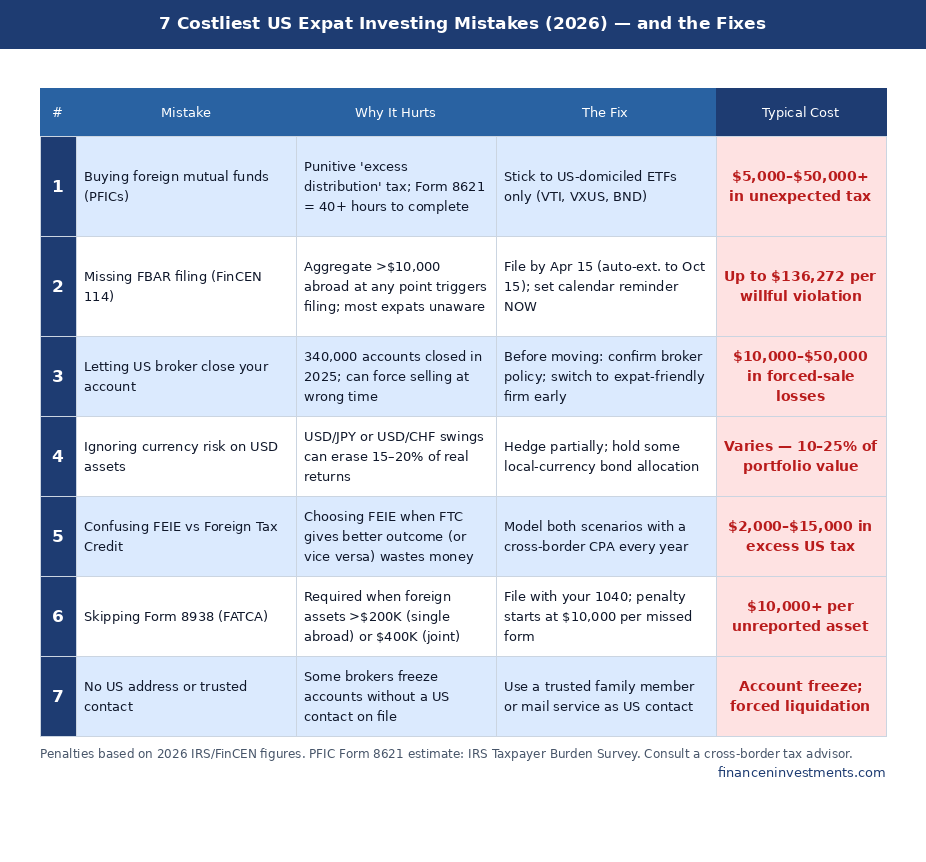
In this article, I analyze the top seven “US Expat Investing Mistakes” that I have seen cause the most damage. They apply whether you have been abroad for two years or twenty. If you are reading this from outside the United States, check yourself against each one.
Welcome to Didi Somm & Team
Disclaimer: This article is for informational purposes only and does not constitute financial, tax, or legal advice. Tax rules for US expats are complex and change frequently. Consult a qualified cross-border tax advisor or CPA before making investment or filing decisions.
Key Takeaways
Moving abroad does not change your US tax obligations by a single line. The IRS taxes American citizens on worldwide income regardless of where they live – one of only two countries in the world that does this. That creates a set of investment traps that do not exist for your local colleagues in Japan, Switzerland, or elsewhere.
Buying a local mutual fund that your neighbor holds without a second thought can cost you tens of thousands in unexpected US tax. Missing a single FBAR filing can result in penalties that dwarf the account balance you forgot to report. And a broker closure you did not see coming can force you to sell at the worst possible time.
The seven mistakes below are the ones I have seen most often – and they are entirely preventable if you know what to look for before they happen.
Table of Contents
Mistake 1: Buying local mutual funds (PFICs)
This is the most expensive and most common mistake. In Japan, Switzerland, Germany, the UK – virtually everywhere – you will be offered local mutual funds and ETFs. They are convenient, available through your local bank, and perfectly normal investments for your local colleagues. For a US citizen, there is a tax trap called a PFIC (Passive Foreign Investment Company).
Under US tax law, any non-US pooled investment vehicle – mutual funds, ETFs domiciled outside the US, unit trusts, most foreign pension fund equivalents – is classified as a PFIC unless it qualifies for an exception. The default tax treatment is punishing. Unless you make a special election (QEF or mark-to-market), gains are taxed at the highest ordinary income rate plus an interest charge calculated back to the year you acquired the fund. The form you file to report each PFIC, Form 8621, is estimated by the IRS Taxpayer Burden Survey to take over 40 hours to complete per fund per year.
The fix is straightforward: hold only US-domiciled funds. VTI (Vanguard Total Market ETF), VXUS (Total International), and BND (Total Bond) are all US-domiciled and trade on US exchanges. You can hold them in a US brokerage account from anywhere in the world – if you keep your US account open (which is the next problem).
Mistake 2: Missing your FBAR filing
FBAR stands for Foreign Bank Account Report, filed as FinCEN Form 114. If the aggregate balance across all your foreign financial accounts exceeds $10,000 at any single moment during the year, you must file. That threshold is lower than most people expect – two accounts with $6,000 each can trigger it if they hit $10,001 together.
The 2026 deadline is April 15, with an automatic extension to October 15. The penalty for a non-willful failure – an honest oversight – can reach $13,627 per violation. A willful violation: $136,272 or 50 percent of the account balance at the time, whichever is greater. Criminal prosecution is possible for the most serious cases.
FBAR is separate from FATCA (Form 8938) and separate from your income tax return. Filing your tax return does not satisfy the FBAR requirement. Set a calendar alert for April 1 every year as a filing reminder.
Mistake 3: Letting your US broker close your account
A reported 340,000 US brokerage accounts were closed in 2025 alone for Americans living abroad. Brokers are not obligated to maintain accounts for non-resident US citizens, and many restrict or close accounts when a foreign address is on file – often with 30 to 90 days’ notice, sometimes less.
The practical damage is significant. A forced account closure means you must sell positions, potentially triggering capital gains taxes at a bad time, and then find a new custodian willing to accept a client with a foreign address. Transferring in-kind to another broker is not always possible when the original account is being closed involuntarily.
The fix is to act before you move abroad. Confirm your current broker’s policy on foreign-address clients. Schwab International, Interactive Brokers, and a small number of specialized expat-focused firms remain open to clients in most countries. If your current broker will not serve your destination country, open a new account before you change your address.
Mistake 4: Ignoring currency risk
Americans abroad often hold the bulk of their investment portfolios in USD-denominated assets, while their daily expenses are in local currency. This creates a hidden risk that is easy to overlook in calm markets and highly visible in turbulent ones.
The JPY/USD rate has moved more than 40 percent in a four-year period. The CHF/USD pair is relatively more stable but still moved roughly 20 percent over a similar window. If your portfolio is 100 percent USD and your cost of living is in yen or francs, a significant currency swing can erase gains that look fine on your brokerage statement but feel painful when converted to pay local bills.
A partial hedge – holding some local-currency bonds or a small allocation in your home-country currency – reduces this exposure without abandoning the USD-denominated growth engine that makes US investing attractive in the first place.
Mistake 5: Choosing the wrong exclusion – FEIE vs the Foreign Tax Credit
The Foreign Earned Income Exclusion (FEIE) lets you exclude up to $126,500 of foreign-earned income from US taxable income in 2026. The Foreign Tax Credit (FTC) lets you offset US taxes dollar-for-dollar with taxes paid to a foreign government. Both exist to prevent double taxation. Choosing the wrong one costs real money, and the correct answer changes depending on your host country’s tax rate, your income level, and whether you have investment income in addition to salary.
In high-tax countries like Japan, Switzerland, or Germany, the Foreign Tax Credit often produces a better outcome – you are paying more in local taxes than you would owe in the US, so the credit fully wipes out US liability. In lower-tax countries, the FEIE may serve you better. The critical point is that the comparison must be modeled every year, because income, rates, and circumstances change. A cross-border CPA who works with US expats is worth the fee for this calculation alone.
Mistake 6: Skipping Form 8938 (FATCA)
FATCA requires reporting foreign financial assets if the total value passes certain thresholds. For expats abroad, the thresholds are $200,000 or more at year-end for single filers, or $400,000 for married filers filing jointly.
Unlike FBAR, Form 8938 covers a broader range of assets – not just accounts, but directly held foreign stocks, interests in foreign partnerships and trusts, and certain foreign life insurance or pension plans with cash value. It is filed with your 1040, not separately. The penalty for failing to file starts at $10,000 per form. Many long-term expats with accumulated foreign assets cross the threshold without realizing the form exists.
Mistake 7: No US address or trusted contact on file
Some brokers will not close your account outright but will restrict trading if they cannot reach you at a US address or if they have no US-based trusted contact on file. This is a softer version of the account closure problem, but equally disruptive if it happens during a market event when you need to act.
The simplest solution is a US mail forwarding service or a trusted US-based family member who can serve as your address and contact of record. Inform your broker proactively when you move. Do not wait for them to discover a foreign address through a returned statement.
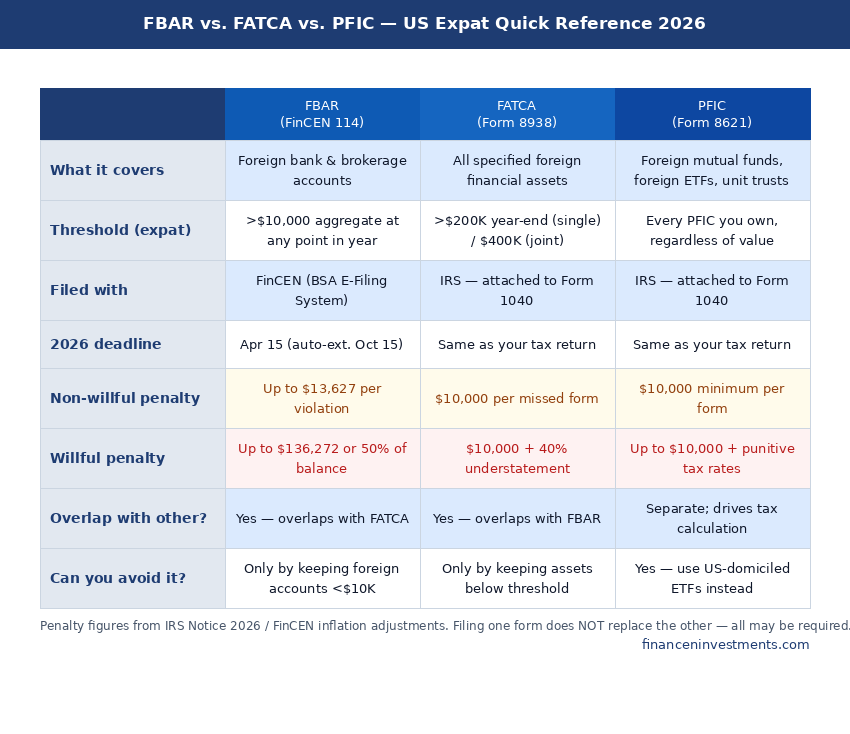
The reporting framework: FBAR, FATCA, and PFIC in one view
These three obligations overlap and confuse even experienced investors. The table below shows exactly how they differ.
FAQ – US Expat Investing Mistakes
Do I have to pay US taxes if I live abroad?
Yes. The United States taxes its citizens on worldwide income regardless of where they live. You must file a US tax return every year as long as your income exceeds the filing threshold, even if you pay taxes in your country of residence.
What is a PFIC, and why should US expats avoid them?
A PFIC is a Passive Foreign Investment Company – any non-US pooled investment fund, including most foreign mutual funds and foreign-domiciled ETFs. The default US tax treatment is punishing: gains are taxed at the highest ordinary income rate plus an interest charge. Most US expats avoid them entirely by holding only US-domiciled ETFs.
What is the FBAR threshold in 2026?
If the aggregate balance across all your foreign financial accounts exceeds $10,000 at any point during the calendar year, you must file FinCEN Form 114 (FBAR) by April 15, with an automatic extension to October 15.
What happens if I miss an FBAR filing?
Non-willful violations can result in penalties up to $13,627 per violation. Willful violations can reach $136,272 or 50 percent of the account balance, whichever is greater. The IRS Streamlined Compliance Procedures offer a reduced-penalty path for non-willful filers who voluntarily catch up.
Is FBAR the same as FATCA?
No. FBAR (FinCEN Form 114) and FATCA (IRS Form 8938) are separate requirements filed with different agencies, covering different assets at different thresholds. If both thresholds are met, both forms are required. Filing one does not satisfy the other.
Which US brokers accept clients with foreign addresses in 2026?
Schwab International, Interactive Brokers, and a small number of expat-specialist custodians remain open to US citizens abroad, though policies vary by country. The key is to confirm your broker’s policy before you move and switch if necessary, while still holding a US address.
Should US expats choose the Foreign Earned Income Exclusion or the Foreign Tax Credit?
It depends on your host country’s tax rate, your income composition, and your specific circumstances. In high-tax countries like Japan, Germany, or Sweden, the Foreign Tax Credit often produces a better outcome. In lower-tax jurisdictions, the FEIE may win. Model both every year with a cross-border CPA.
What is the FATCA threshold for US expats living abroad?
For single filers living abroad, FATCA reporting (Form 8938) is required when specified foreign financial assets exceed $200,000 at year-end or $300,000 at any point during the year. For married filing jointly: $400,000 at year-end or $600,000 at any point.
Can I avoid PFIC exposure while still investing internationally?
Yes. US-domiciled ETFs like VXUS (Vanguard Total International Stock ETF) give you global diversification while remaining US-registered, so they are not PFICs. Hold international exposure through US-issued funds rather than locally purchased ones.
What are the Streamlined Filing Compliance Procedures?
An IRS program that allows non-willful non-filers to catch up on up to three years of tax returns and six years of FBARs with significantly reduced or zero penalties for qualifying expats. It requires certifying that the failure was non-willful. Work with a specialist CPA to use it correctly.
What to do if you have already made one of these mistakes
The IRS offers the Streamlined Filing Compliance Procedures for US expats who have not been filing correctly but whose failure was non-willful. This program allows you to catch up on up to 3 years of tax returns and 6 years of FBARs, with a reduced penalty of 0 for non-resident filers. It is not indefinitely available – the IRS can close the program – so if you have a backlog, address it sooner rather than later. Work with a CPA who specializes in US expat compliance, not a generalist.
Good luck with your future investments!
Didi Somm & Team
Recently published articles include:
- Mega Backdoor Roth 2026: The $70,000 Loophole Most People Miss
- Fidelity vs Schwab vs Vanguard 2026: Honest Cost Breakdown
- ChatGPT Portfolio Management: 30 Days, 5 Tests, 2 Failures
- 401k Contribution Limits 2026: The Complete Optimization Guide
- BACKDOOR ROTH IRA – All You Need To Know in 2026
- Roth IRA Guide: Your Roadmap to Tax-Free Retirement Wealth
- The 3-Fund Portfolio: A Complete Guide to Simple, Powerful Investing
About the Author
Didi Somm spent 30+ years in international banking and commerce. He also runs dorealadvice.com, a business-intelligence platform. He writes here about building wealth with clarity and discipline.
Disclaimer: This article is for informational purposes only and does not constitute financial, tax, or legal advice. Tax rules for US expats are complex and change frequently. Consult a qualified cross-border tax advisor or CPA before making investment or filing decisions.