

The number that catches people off guard is $72,000.
That is the total amount the IRS allows to go into a 401(k) from all sources in 2026 – your own contributions, your employer’s match, and a third bucket almost nobody uses: after-tax contributions. Most of the financial internet focuses on the $24,500 employee deferral limit and stops there. That leaves as much as $47,500 on the table for people who know how to pick it up.
The strategy that picks it up is called the Mega Backdoor Roth 2026, and in 2026, it is more relevant than ever – especially for high earners who are already phased out of direct Roth IRA contributions above $153,000 (single) or $242,000 (married filing jointly).
Welcome to Didi Somm & Team
Disclaimer: This article is for educational purposes only and is not financial, tax, or investment advice. Fee and rate information reflects publicly available data as of 2026 and is subject to change. Always verify current rates and terms directly with the relevant institution before making decisions.
Key Takeaways
Most people max out their 401(k) at $24,500 and think they are done. They are not. The Mega Backdoor Roth is a second door into the same building – and it is nearly ten times bigger. In 2026, the IRS allows up to $72,000 in total contributions to a 401(k) from all sources.
If your plan permits after-tax contributions and in-plan Roth conversions, you can funnel the gap between what you and your employer already contribute and that $72,000 ceiling straight into a Roth account – tax-free growth from that moment on. Most Fortune 500 plans now support it. Smaller employers often do not, but self-employed people can build a Solo 401(k) that does. You must act inside the same tax year, and you must convert fast to minimize taxable earnings.
Table of Contents
What the Mega Backdoor Roth actually is
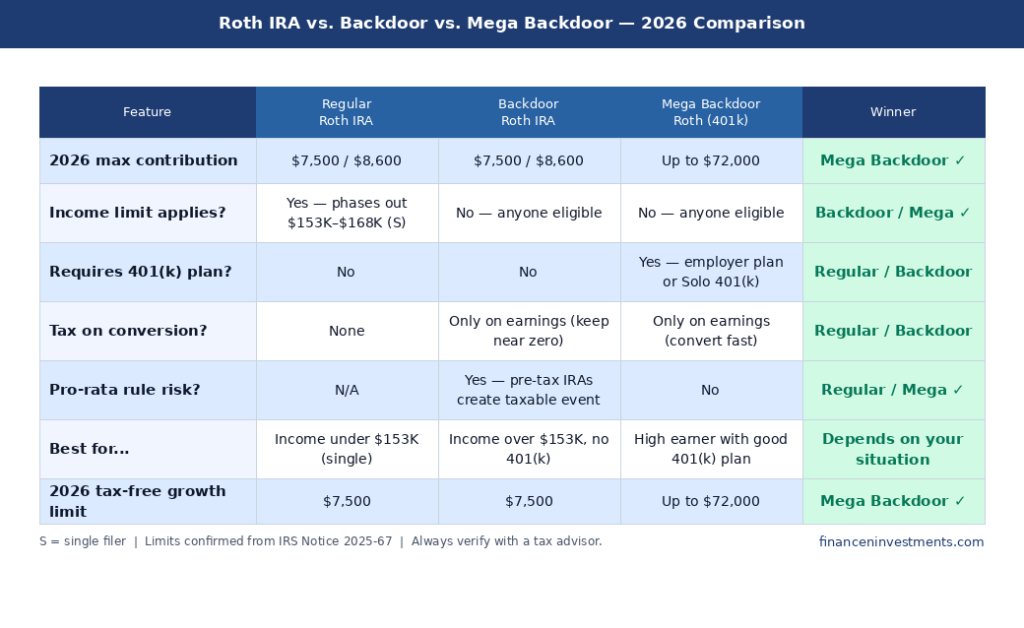
The regular backdoor Roth IRA lets you contribute $7,500 to a non-deductible traditional IRA and immediately convert it to a Roth IRA. Useful, but the ceiling is low. The Mega Backdoor Roth uses the 401(k) instead of the IRA, which is why the numbers are so much larger.
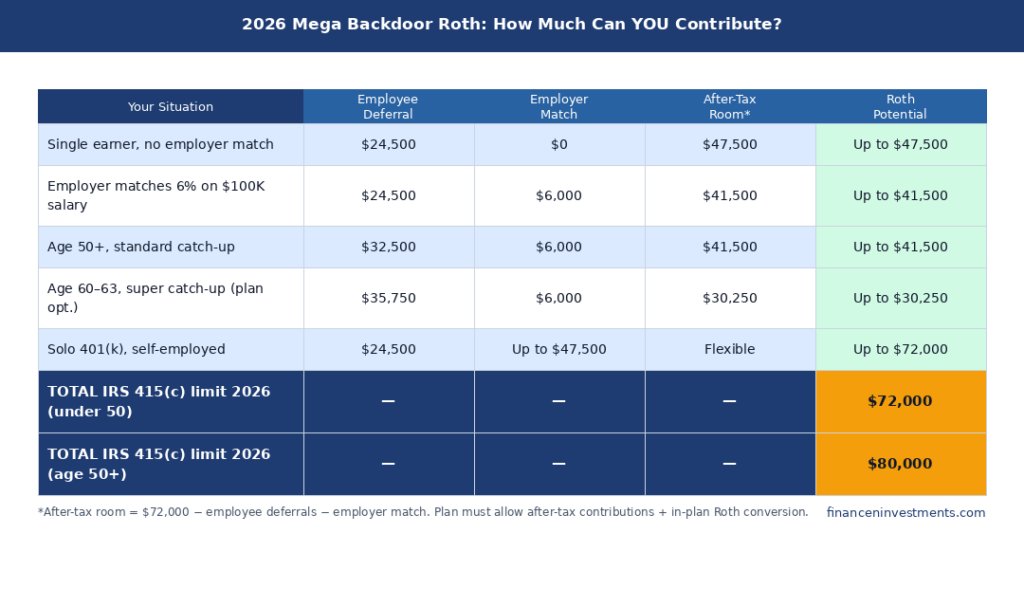
Here is the mechanical structure. The IRS sets two separate limits for 401(k) plans. First, the employee elective deferral limit is $24,500 in 2026, or $32,500 if you are 50 or older, with the standard catch-up. Second, the Section 415(c) total annual addition limit: $72,000 in 2026 ($80,000 for those 50 and over). That $72,000 ceiling covers every dollar going into the plan – your deferrals, the employer match, and any after-tax contributions. The gap between what you and your employer already contribute and $72,000 is the Mega Backdoor window.
If your employer matches 6% on a $100,000 salary, that is $6,000. Add your $24,500 deferral: $30,500 total already in the plan. The remaining $41,500 is yours to fill with after-tax dollars – and then immediately convert to Roth.
The two plan features you need
The strategy only works if your 401(k) plan allows both of the following.
First, after-tax (non-Roth) contributions beyond the standard deferral limit. These are separate from Roth 401(k) contributions. They go in on an after-tax basis, but they are not Roth yet – the conversion step is what makes them Roth.
Second, either in-plan Roth conversions or in-service withdrawals. In-plan conversions let you flip those after-tax dollars to Roth inside the same plan. In-service withdrawals let you pull the money out while still employed and roll it into a Roth IRA outside the plan. Either works, though in-plan conversions are cleaner and available at more employers.
Tech companies, including Google, Microsoft, Amazon, Meta, and Apple, all offer both features. Many Fortune 500 plans now follow. Smaller employers are less likely to offer this. If yours does not, the path forward is to ask HR directly – plan sponsors can add both features without a major overhaul, and some do when employees ask.
Self-employed individuals have a cleaner route. A properly structured Solo 401(k) can include both after-tax contributions and in-plan Roth conversions, which means a solo operator can potentially shelter the entire $72,000 in Roth accounts in a single year – ten times what a regular Roth IRA allows.
Why you need to convert fast
After-tax contributions inside the plan do not yet have earnings that are Roth. Those earnings are pre-tax and will be taxable upon conversion. The goal is to convert the same day the contribution posts, or within the same week. At that point, earnings are nearly zero, so the taxable amount is negligible. If you wait months, earnings accumulate, and the conversion becomes a partial taxable event. The phrase used in practitioner circles is “isolate the basis,” meaning you want to convert only your after-tax contributions, not mixed earnings.
The SECURE Act 2.0 wrinkle for high earners in 2026
Starting January 1, 2026, a SECURE Act 2.0 provision changes how catch-up contributions work for higher earners. If you earned more than $150,000 in FICA wages from your employer in 2025, your catch-up contributions to the 401(k) must now go in as Roth – not pre-tax. This applies to anyone aged 50 or older above that wage threshold.
This does not eliminate the Mega Backdoor Roth strategy. It is a separate requirement affecting only the catch-up portion of deferrals. But it matters for 2026 planning: if you are over 50, over $150,000 in wages, and your plan does not yet offer a Roth designation for catch-up contributions, those contributions are effectively frozen until your employer updates the plan. Most large plan administrators have complied; smaller plans may still be catching up.
How Mega Backdoor compares to the regular Roth and Backdoor alternatives
Who this strategy is and is not for
This strategy is most powerful for high earners – typically household incomes above $200,000 – who have already maxed their 401(k) deferral and Roth IRA (via the regular backdoor), and who have meaningful savings capacity beyond that. If you are still building your emergency fund or paying off high-interest debt, the Mega Backdoor Roth can wait.
It is also highly plan-specific. You cannot execute this strategy if your employer’s 401(k) does not support after-tax contributions. Check your Summary Plan Description (SPD), which your HR department is legally required to provide. Look for the phrase “after-tax employee contributions.” If it is not there, the door is closed at your current employer.
Self-employed business owners – sole proprietors, LLC members, S-corp owners – have significant control over Solo 401(k) plan design and can typically add both required features through a plan administrator such as Fidelity, Schwab, or a specialist provider like IRA Financial.
The step-by-step execution
Step one: Confirm your plan allows after-tax contributions and in-plan Roth conversions. Read the SPD or ask HR in writing.
Step two: Calculate your available space. Take $72,000, subtract your planned employee deferrals, and subtract your expected employer match. The remainder is your maximum after-tax contribution for 2026.
Step three: Set up after-tax contributions through payroll. You typically elect a percentage of each paycheck to go in as after-tax.
Step four: Convert immediately after each contribution post. Most platforms allow you to initiate an in-plan Roth conversion online. Same-day or same-week is the target.
Step five: Report correctly. The after-tax contributions appear on your W-2 in Box 12 with code “AA” or “BB.” The conversion generates a Form 1099-R. Your tax preparer needs both.
FAQ – Mega Backdoor Roth 2026
What is the Mega Backdoor Roth limit in 2026?
The total 401(k) limit under IRS Section 415(c) is $72,000 for workers under 50, and $80,000 for those 50 and older, including standard catch-up. Your Mega Backdoor Roth potential is that ceiling minus your employee deferrals and employer match.
Is the Mega Backdoor Roth available to everyone?
No. Your employer’s 401(k) plan must allow after-tax contributions and either in-plan Roth conversions or in-service withdrawals. Many large corporate plans offer both; many smaller plans do not. Self-employed individuals can structure a Solo 401(k) to allow it.
Can I do a Mega Backdoor Roth if my income is too high for a regular Roth IRA?
Yes. The Mega Backdoor Roth has no income limit. It is specifically useful for high earners who are phased out of direct Roth IRA contributions (above $153,000 single / $242,000 married filing jointly in 2026).
How is the Mega Backdoor Roth different from the regular backdoor Roth?
The regular backdoor Roth uses a traditional IRA and has a $7,500 limit in 2026. The Mega Backdoor Roth uses after-tax 401(k) contributions and can involve up to $ 47,500 in additional Roth contributions. They can be used in the same year.
What happens if I do not convert the after-tax contributions immediately?
Earnings on after-tax contributions are pre-tax and become taxable upon conversion. Converting quickly – ideally, the same day – keeps taxable earnings at or near zero.
Does the SECURE 2.0 catch-up rule affect the Mega Backdoor Roth?
Indirectly. Workers earning over $150,000 in prior-year wages who are 50 or older must now make catch-up contributions to a Roth. This affects only the catch-up portion of deferrals, not the after-tax contribution strategy itself.
Can I do a Mega Backdoor Roth with a Solo 401(k)?
Yes, and for the self-employed, this is one of the most powerful versions. A properly structured Solo 401(k) can allow after-tax contributions and in-plan Roth conversions, potentially sheltering the full $72,000 in Roth status in 2026.
What if my plan allows after-tax contributions but not in-plan conversions?
You can still execute the strategy using in-service withdrawals, which allow you to take the after-tax balance from the plan while you’re still employed and roll it into a Roth IRA. Not all plans allow in-service withdrawals, so confirm with your plan documents.
Is the pro-rata rule a problem for the Mega Backdoor Roth?
No. The pro-rata rule applies to IRA conversions, not 401(k) conversions. The Mega Backdoor Roth operates entirely within the 401(k) structure, so IRA balances do not affect the tax calculation.
Where do I find out if my plan allows the Mega Backdoor Roth?
Ask HR for the Summary Plan Description (SPD) and look for the phrase “after-tax employee contributions.” You can also search your 401(k) platform’s contribution election options — some plans show a separate after-tax contribution election alongside pre-tax and Roth options.
{ “@context”: “https://schema.org”, “@type”: “FAQPage”, “mainEntity”: [ {“@type”:”Question”,”name”:”What is the Mega Backdoor Roth limit in 2026?”,”acceptedAnswer”:{“@type”:”Answer”,”text”:”The total 401(k) limit under IRS Section 415(c) is $72,000 for workers under 50, and $80,000 for those 50 and older including standard catch-up. Your Mega Backdoor Roth potential is that ceiling minus your employee deferrals and employer match.”}}, {“@type”:”Question”,”name”:”Is the Mega Backdoor Roth available to everyone?”,”acceptedAnswer”:{“@type”:”Answer”,”text”:”No. Your employer’s 401(k) plan must allow after-tax contributions and either in-plan Roth conversions or in-service withdrawals. Many large corporate plans offer both; many smaller plans do not. Self-employed individuals can structure a Solo 401(k) to allow it.”}}, {“@type”:”Question”,”name”:”Can I do a Mega Backdoor Roth if my income is too high for a regular Roth IRA?”,”acceptedAnswer”:{“@type”:”Answer”,”text”:”Yes. The Mega Backdoor Roth has no income limit. It is specifically useful for high earners phased out of direct Roth IRA contributions — above $153,000 single or $242,000 married filing jointly in 2026.”}}, {“@type”:”Question”,”name”:”How is the Mega Backdoor Roth different from the regular backdoor Roth?”,”acceptedAnswer”:{“@type”:”Answer”,”text”:”The regular backdoor Roth uses a traditional IRA and has a $7,500 limit in 2026. The Mega Backdoor Roth uses after-tax 401(k) contributions and can involve up to $47,500 or more in additional Roth dollars. Both can be used in the same year.”}}, {“@type”:”Question”,”name”:”What happens if I do not convert the after-tax contributions immediately?”,”acceptedAnswer”:{“@type”:”Answer”,”text”:”Earnings on after-tax contributions are pre-tax and become taxable upon conversion. Converting quickly — ideally the same day — keeps taxable earnings at or near zero.”}}, {“@type”:”Question”,”name”:”Does the SECURE 2.0 catch-up rule affect the Mega Backdoor Roth?”,”acceptedAnswer”:{“@type”:”Answer”,”text”:”Indirectly. Workers earning over $150,000 in prior-year wages who are 50 or older must now make catch-up contributions as Roth. This affects the catch-up portion of deferrals only, not the after-tax contribution strategy itself.”}}, {“@type”:”Question”,”name”:”Can I do a Mega Backdoor Roth with a Solo 401(k)?”,”acceptedAnswer”:{“@type”:”Answer”,”text”:”Yes. A properly structured Solo 401(k) can allow after-tax contributions and in-plan Roth conversions, potentially sheltering up to $72,000 in Roth status in 2026.”}}, {“@type”:”Question”,”name”:”What if my plan allows after-tax contributions but not in-plan conversions?”,”acceptedAnswer”:{“@type”:”Answer”,”text”:”You can use in-service withdrawals, which allow you to move after-tax balances out of the plan while still employed and roll them into a Roth IRA. Confirm this option with your plan documents.”}}, {“@type”:”Question”,”name”:”Is the pro-rata rule a problem for the Mega Backdoor Roth?”,”acceptedAnswer”:{“@type”:”Answer”,”text”:”No. The pro-rata rule applies to IRA conversions, not 401(k) conversions. The Mega Backdoor Roth operates entirely within the 401(k) structure, so IRA balances do not affect the tax calculation.”}}, {“@type”:”Question”,”name”:”Where do I find out if my plan allows the Mega Backdoor Roth?”,”acceptedAnswer”:{“@type”:”Answer”,”text”:”Ask HR for the Summary Plan Description (SPD) and look for the phrase ‘after-tax employee contributions.’ You can also search your 401(k) platform’s contribution election options for a separate after-tax election.”}} ] }
Is the Mega Backdoor Roth at risk of being closed?
This question comes up every year. The strategy has survived multiple rounds of Congressional attention, including explicit proposals to limit it in 2021’s Build Back Better Act, which ultimately did not pass. As of 2026, it remains fully legal and IRS-acknowledged. That said, tax law changes, and it is reasonable to use the strategy while it is available rather than assuming it will remain unchanged indefinitely.
Good luck with your investments!
Didi Somm & Team
Recently published articles include:
- Fidelity vs Schwab vs Vanguard 2026: Honest Cost Breakdown
- ChatGPT Portfolio Management: 30 Days, 5 Tests, 2 Failures
- 401k Contribution Limits 2026: The Complete Optimization Guide
- BACKDOOR ROTH IRA – All You Need To Know in 2026
- Roth IRA Guide: Your Roadmap to Tax-Free Retirement Wealth
- The 3-Fund Portfolio: A Complete Guide to Simple, Powerful Investing
- Value vs Growth Investing: Which Strategy Wins in 2026?
- Active vs Passive Investing – Your Best Guide
Disclaimer: This article is for educational purposes only and is not financial advice. Investing involves risk, including potential loss of principal. Consider consulting a financial advisor for personalized advice. Past performance does not guarantee future results. All dollar amounts and projections are illustrative examples only. Tax situations vary – consult a tax professional for specific guidance
About the Author
Didi Somm spent 30+ years in international banking and commerce. He also runs dorealadvice.com, a business-intelligence platform. He writes here about building wealth with clarity and discipline.