

The first paycheck from your first real job is a moment you remember. What most 22-year-olds don’t remember is the HR onboarding packet they half-read two weeks before – the one with the 401k enrollment form buried somewhere in the middle.
I spent 30 years in international banking watching how wealth actually accumulates, and the pattern is consistent: the people who build serious retirement savings are almost never the ones who earned the most. They are the ones who started the habit earliest and left it alone the longest. The difference between enrolling in your 401k at 22 versus 32 is not one decade of contributions – it is a compounding gap that can easily exceed $500,000 by retirement age.
This is the first job 401k advice I wish someone had given me on day one. Five moves, in the right order, with the 2026 numbers you actually need.
Welcome to Didi Somm & Team
Disclaimer: This article is for educational purposes only and is not financial, tax, or investment advice. Contribution limits are based on IRS 2026 figures and subject to change. Consult a qualified financial professional before making investment decisions.
KEY TAKEAWAYS
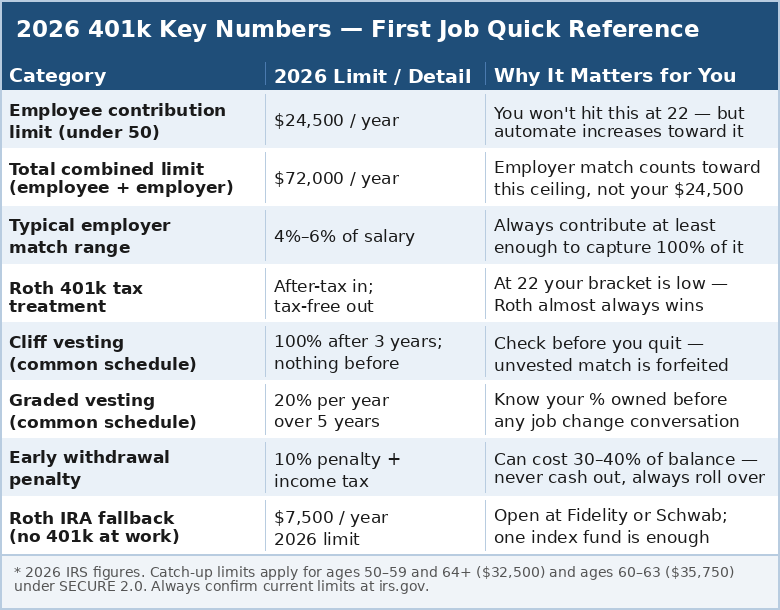
- The 2026 employee 401k contribution limit is $24,500 – you won’t hit it on your first salary, but knowing the ceiling helps you plan
- Never leave free money on the table: always contribute at least enough to get your full employer match before anything else
- Understand your vesting schedule before you quit – unvested employer contributions disappear when you leave
- Roth 401k is almost always the better choice at 22 – your tax bracket will likely never be lower than it is right now
- Automating annual contribution increases of just 1% per year is the single most powerful retirement move most young workers never make
Table of Contents
Move 1: Enroll immediately – don’t wait for the “right” moment
Most 401k plans allow you to enroll within 30 to 90 days of your start date. Some now auto-enroll you at a default rate, usually 3%. Either way, the worst thing you can do is delay.
Here is why timing matters more than you think: every month you wait is a month of employer match you forfeit and a month of compounding you never get back. On a $60,000 starting salary with a 4% employer match, delaying enrollment by six months costs you $1,200 in free employer money – before a single dollar of your own contributions.
Action step: Log into your HR portal this week, find the 401k enrollment section, and set your contribution rate. If you are overwhelmed, set it to whatever captures the full employer match and revisit it in six months. Done is better than optimized.
Move 2: Get the full employer match – every dollar of it
The employer match is the closest thing to a guaranteed return that exists in investing. If your employer matches 100% of your contributions up to 4% of salary, contributing 4% gives you an immediate 100% return on that portion of your money. No investment comes close to that on day one.
The average employer match in the US runs 4% to 6% of salary. Some are more generous – Visa, for example, matches 200% of the first 5% of pay. Some are less. What matters is that you know your specific formula and contribute exactly enough to capture all of it.
Two things to check that most new employees miss: first, confirm whether your plan has a true-up provision. If you front-load contributions early in the year and hit the IRS limit before December, some plans stop matching – and you miss the match on your later paychecks even though you contributed more overall. Second, check whether the match is on base salary only or total compensation including bonus – the distinction can be meaningful.
Move 3: Choose Roth 401k if your plan offers it
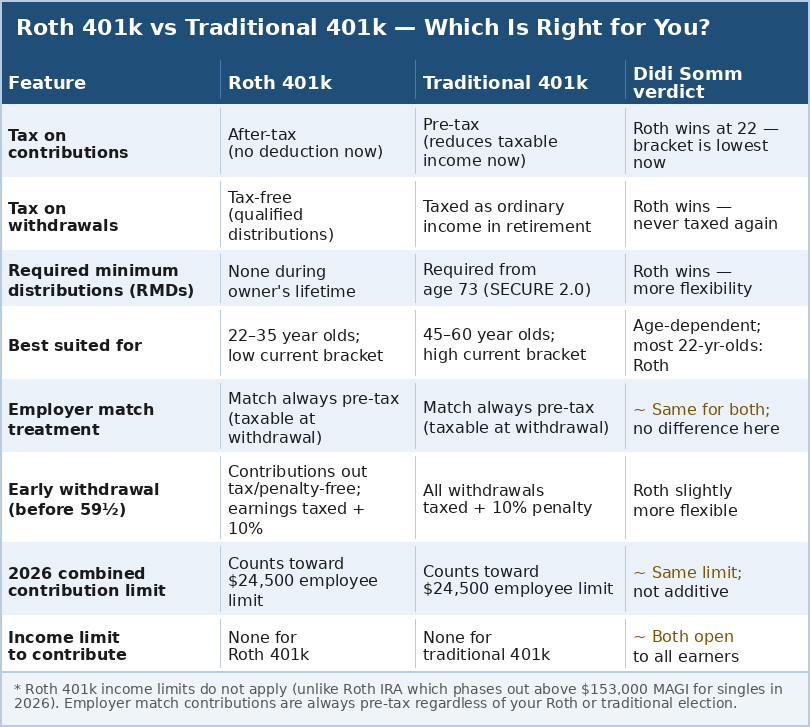
Many 401k plans now offer a Roth option alongside the traditional pre-tax choice. At 22, the Roth is almost always the right answer – and here is the reasoning from someone who has watched this play out over decades.
With a traditional 401k, you contribute pre-tax dollars and pay tax when you withdraw in retirement. With a Roth 401k, you contribute after-tax dollars and pay no tax on withdrawals in retirement. The trade-off hinges on your tax rate now versus your tax rate later.
At 22, you are almost certainly in the lowest tax bracket of your entire career. Your salary will (you hope) grow significantly over the next 40 years. Paying tax now at a low rate, and never paying tax again on that money or its growth, is mathematically the better deal for most young earners. The only exception is if you genuinely believe your retirement income will be lower than your current income – possible if you plan to retire early or have very modest expectations.
One practical note: employer match contributions are always made pre-tax regardless of whether you choose the Roth option. So even in a Roth 401k, the match side of your account will be taxable at withdrawal.
Move 4: Understand your vesting schedule before you think about leaving
Your own contributions to a 401k are always 100% yours immediately. The employer match is a different story.
Most employers impose a vesting schedule – a period of time you must work before you fully own the employer’s contributions. Common formats include cliff vesting (100% ownership after 3 years, nothing before) and graded vesting (incremental ownership, e.g. 20% per year over 5 years). Some plans vest immediately – check yours before assuming.
Why this matters practically: if you are considering leaving your job at the 2-year mark and your plan has 3-year cliff vesting, you will walk away from every dollar your employer has contributed. That could be $5,000 to $15,000 depending on your salary and match rate. In some cases, it is worth waiting a few more months. Always check the vesting calendar before you give notice.
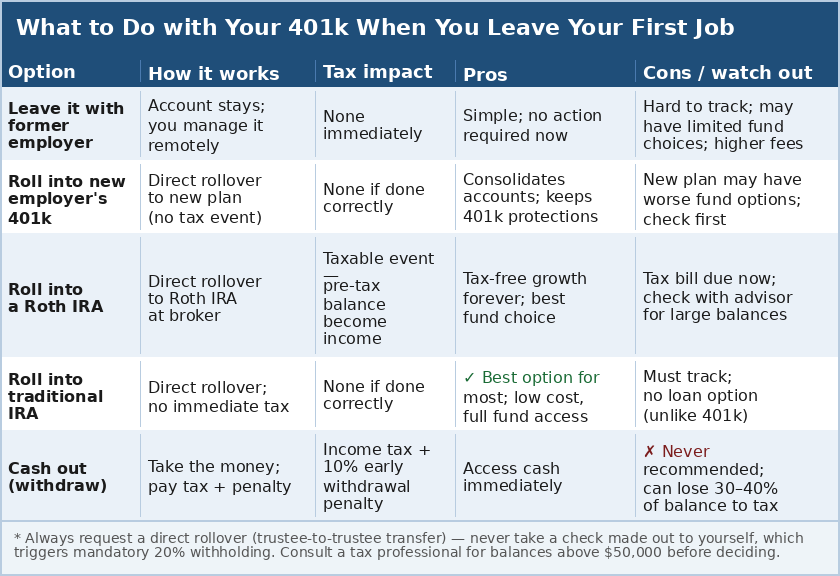
When you do leave, do not cash out the 401k. The tax and early withdrawal penalties (10% penalty plus income tax) can consume 30% to 40% of the balance. Roll it into your new employer’s plan or into a traditional IRA instead.
Move 5: Automate annual increases – the 1% trick
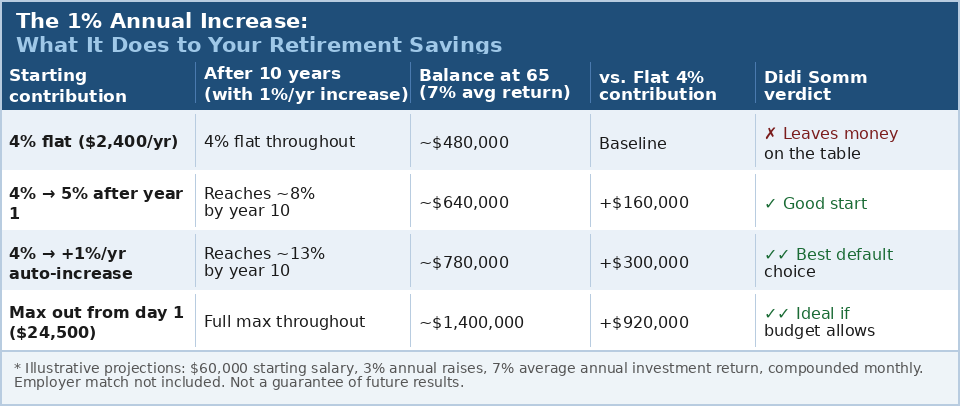
Once you are contributing enough to capture the full match, set up automatic annual contribution increases of 1% per year. Most modern 401k platforms offer this as a feature – it usually takes two minutes to activate.
Here is what this does in practice: on a $60,000 salary contributing 4% today, a 1% annual increase brings you to a 10% contribution in six years – without you ever feeling a significant reduction in take-home pay because each increase coincides with a pay rise. You never notice the money you never see.
Over a 40-year career, the difference between contributing 4% constantly versus increasing by 1% per year for the first decade can exceed $300,000 in retirement savings at a 7% average annual return. It is the most powerful retirement move most young workers never make, because it requires no discipline after the first setup.
What to do if your employer has no 401k plan
Some smaller employers, particularly in the first years of a startup’s life, do not offer a 401k. In that case, open a Roth IRA immediately. The 2026 Roth IRA contribution limit is $7,500 ($8,600 if you are 50 or over). A Roth IRA at Fidelity or Schwab with a single broad index fund is an excellent proxy for a 401k until your employer adds a plan – or until you move to one that has one.
FAQ – “first job 401k advice”
What is the 401k contribution limit for 2026?
The employee contribution limit for 2026 is $24,500 for workers under 50. Workers aged 50 to 59 and 64 and above can contribute up to $32,500. Workers aged 60 to 63 can contribute up to $35,750 under SECURE 2.0 provisions. The combined employee plus employer limit is $72,000.
Should I choose a Roth or traditional 401k at my first job?
For most 22-year-olds, the Roth 401k is the better choice. You are likely in the lowest tax bracket of your career, so paying tax now and never paying tax on the growth is mathematically advantageous for most young earners.
How much should I contribute to my 401k at my first job?
At minimum, contribute enough to capture your full employer match. Beyond that, aim to increase gradually toward 10-15% of salary over the first decade of your career. The 1% annual automatic increase is the most practical way to get there.
What is a vesting schedule and why does it matter?
A vesting schedule determines when you fully own the employer’s matching contributions. Your own contributions are always 100% yours. Employer contributions may require 1 to 6 years of service before they fully belong to you. Always check your vesting timeline before resigning.
What happens to my 401k if I leave my first job?
Your own contributions are always yours. Unvested employer contributions are forfeited. For the vested balance, your options are to leave it with the former employer’s plan, roll it into your new employer’s 401k, or roll it into an IRA. Never cash it out — early withdrawal penalties and taxes can consume 30-40% of the balance.
What is an employer match and how does it work?
An employer match is a contribution your employer makes to your 401k based on how much you contribute. A common formula is 100% match on the first 4% of salary — meaning if you earn $60,000 and contribute 4% ($2,400), your employer adds another $2,400. It is free money that you forfeit if you do not contribute enough to trigger it.
What if my employer does not offer a 401k?
Open a Roth IRA immediately. The 2026 limit is $7,500. Choose a low-cost broker such as Fidelity or Schwab and invest in a broad total-market index fund. This is an excellent retirement savings vehicle until you have access to a 401k.
How does compounding make early contributions so valuable?
Money invested at 22 has 40+ years to grow. At a 7% average annual return, $1,000 invested at 22 becomes approximately $15,000 by age 65. The same $1,000 invested at 32 becomes roughly $7,600. Starting a decade earlier more than doubles the outcome.
Can I contribute to both a 401k and a Roth IRA?
Yes. Contributing to a 401k does not affect your Roth IRA eligibility as long as your income falls within the Roth IRA phase-out limits. For 2026, single filers can contribute the full Roth IRA amount up to $153,000 in MAGI.
What funds should I choose inside my 401k?
For most 22-year-olds, a single target-date fund set to your expected retirement year is the simplest and most appropriate choice. If you want more control, a combination of a US total market index fund and an international index fund covers 90% of what you need at the lowest possible cost.
What is a true-up provision and do I need to worry about it?
A true-up provision ensures you receive your full annual employer match even if you hit the contribution limit before year-end. Not all plans have this. If yours does not, spread your contributions evenly across all 12 months rather than front-loading to avoid missing match payments on later paychecks.
Is it worth contributing above the employer match?
Yes, once you have no high-interest debt and a basic emergency fund. Max out the Roth 401k if possible, or at minimum increase by 1% per year. The tax-free or tax-deferred growth on every additional dollar is valuable — especially at 22 when those dollars have 40+ years to compound.
Conclusion
The 401k decisions you make in your first job are disproportionately important – not because the amounts are large, but because the habits are forming and the compounding clock is starting. Enroll immediately, capture every dollar of employer match, choose Roth if you can, understand your vesting schedule, and automate the annual increases. Five moves, most of which take under 30 minutes total to execute. The 22-year-old who does all five is already ahead of the majority of their colleagues who will revisit this decision at 35 and wish they had started earlier.
Good luck with your future investments!
Didi Somm & Team
Recently published articles include:
- US Expat Investing Mistakes: The Top 7 That Cost $50,000 or More
- Mega Backdoor Roth 2026: The $70,000 Loophole Most People Miss
- Fidelity vs Schwab vs Vanguard 2026: Honest Cost Breakdown
- ChatGPT Portfolio Management: 30 Days, 5 Tests, 2 Failures
- 401k Contribution Limits 2026: The Complete Optimization Guide
- BACKDOOR ROTH IRA – All You Need To Know in 2026
- Roth IRA Guide: Your Roadmap to Tax-Free Retirement Wealth
About the author
Didi Somm spent 30+ years in international banking and commerce. He also runs dorealadvice.com, a business-intelligence platform. He writes here about building wealth with clarity and discipline.
Disclaimer: This article is for educational purposes only and is not financial, tax, or investment advice. Contribution limits are based on IRS 2026 figures and subject to change. Consult a qualified financial professional before making investment decisions.