
Roth IRA Guide – Introduction
Only 21% of American workers have access to a Roth account through their employer, leaving the vast majority to navigate Roth IRAs on their own, often without a clear roadmap. If you’ve been told a Roth IRA is “just another retirement account,” you’ve been given incomplete information that could cost you hundreds of thousands in tax-free growth over your lifetime.
With the 2025 contribution limits now in effect and income thresholds adjusted for inflation, this is a pivotal moment to either establish your Roth IRA or optimize an existing account. The tax-free compounding engine of a Roth IRA represents one of the most powerful wealth-building tools available to individual investors – but only when you understand precisely how to harness its full potential.
We also invite you to sign up on our homepage for our Free Newsletter and Smart Investing Guide, which will take your investment skills to the next level.
Didi Somm & Team
Disclaimer: This article is for educational purposes only and is not financial advice. Investing involves risk, including potential loss of principal. Consider consulting a financial advisor for personalized advice. Past performance does not guarantee future results. All dollar amounts and projections are illustrative examples only. Tax situations vary – consult a tax professional for specific guidance
Key Takeaways
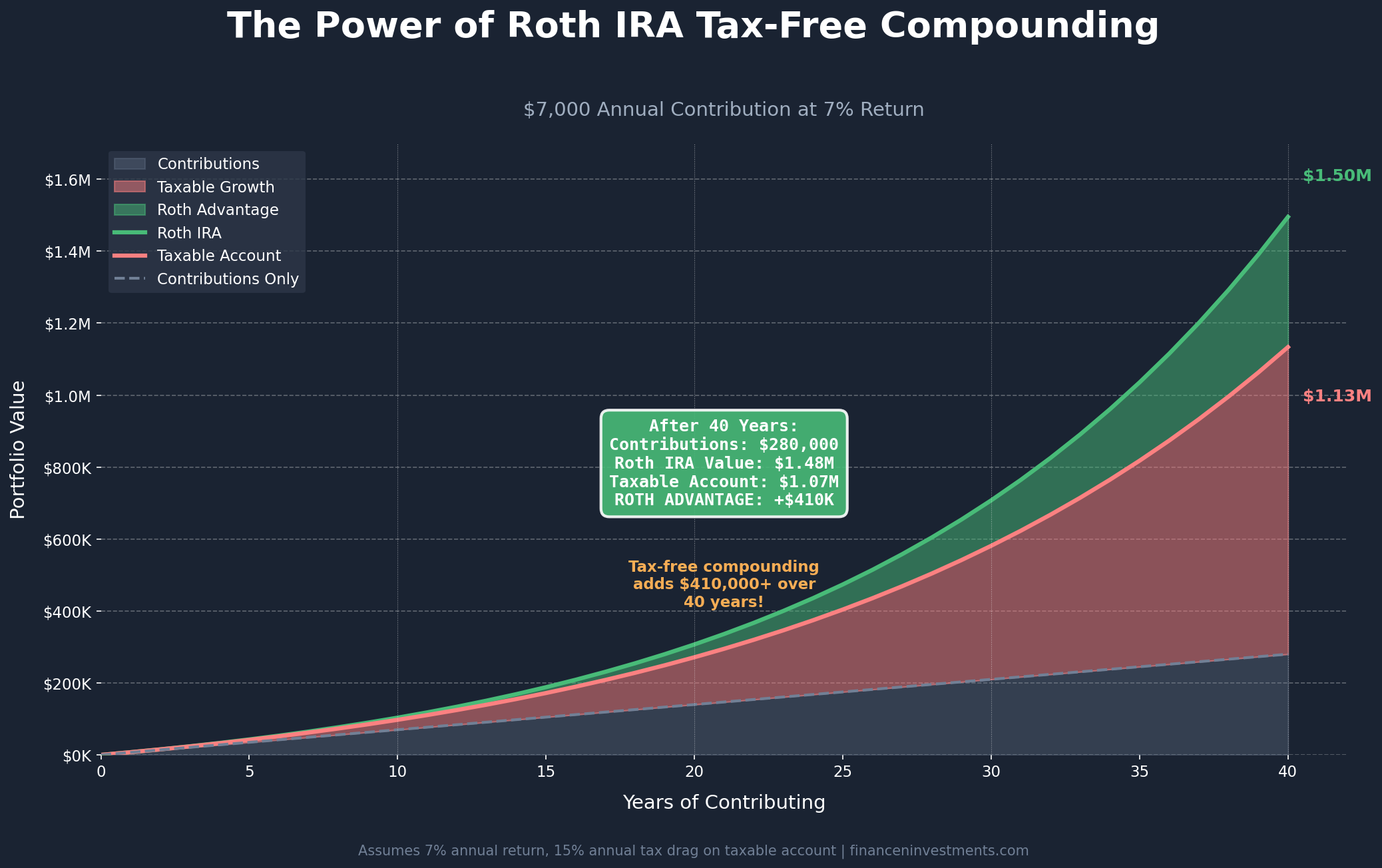
Tax-Free Growth Changes Everything: A Roth IRA allows your investments to compound without ever being diminished by taxes. A $7,000 annual contribution growing at 7% for 30 years produces approximately $700,000 – with roughly $490,000 in gains you’ll never pay taxes on. This compounding advantage accelerates dramatically over longer time horizons.
Income Limits Create Strategic Opportunities: In 2025, single filers earning above $165,000 and married couples filing jointly earning above $246,000 cannot contribute directly to a Roth IRA. However, the “backdoor Roth” strategy remains fully legal, allowing high earners to access Roth benefits through a two-step conversion process that circumvents income restrictions.
Withdrawal Flexibility Provides Financial Security: Unlike traditional retirement accounts, Roth IRA contributions can be withdrawn at any time without taxes or penalties. This creates a financial safety net during wealth accumulation while preserving tax-free growth for retirement – a dual benefit no other account offers.
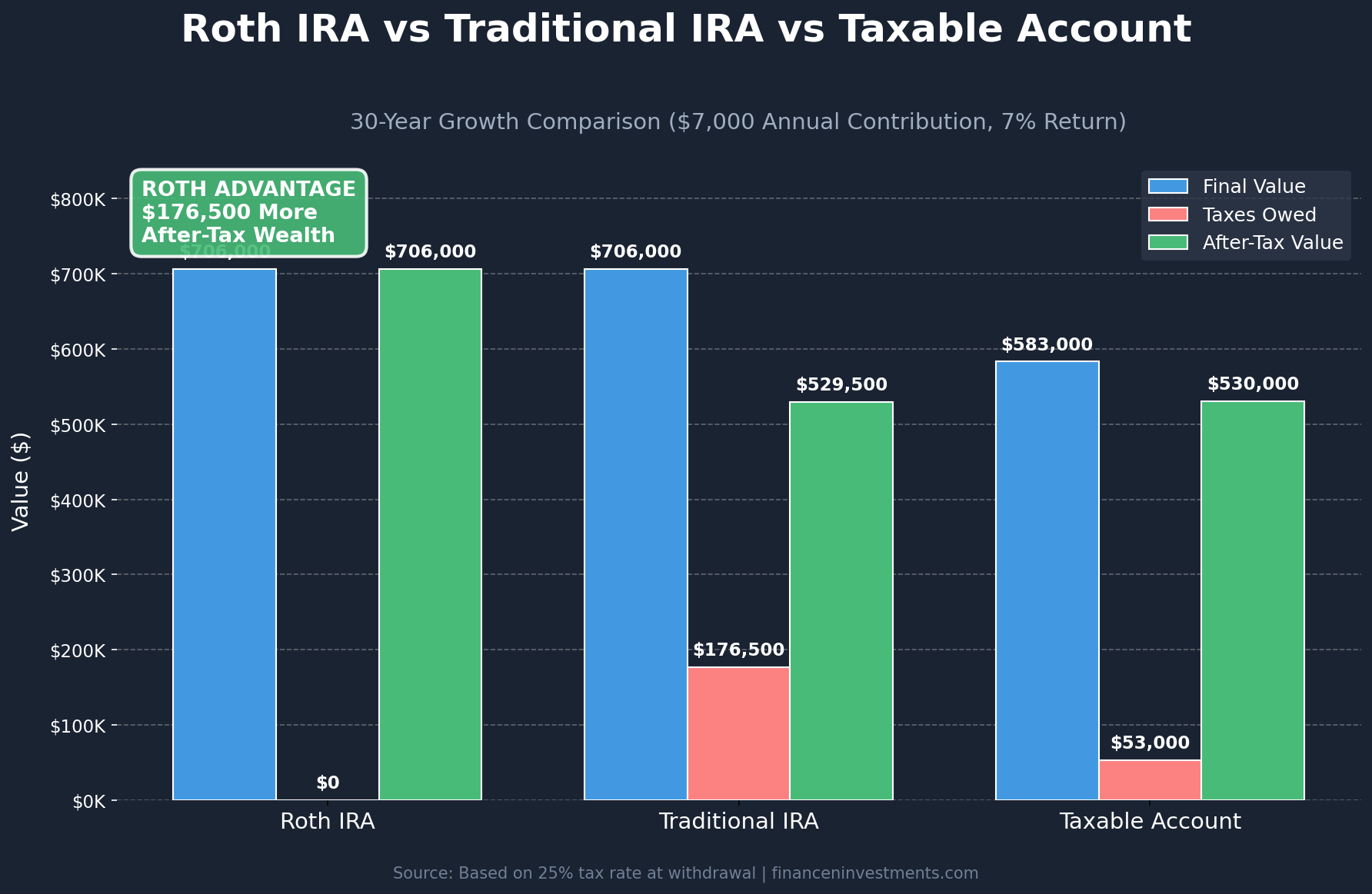
Table of Contents
What a Roth IRA Really Means (And Why Most Get It Wrong)
A Roth IRA is an individual retirement account funded with after-tax dollars, where qualified withdrawals- including all investment gains – are completely tax-free. Named after Senator William Roth, who championed the legislation creating these accounts in 1997, the Roth IRA operates on a fundamentally different tax philosophy than traditional retirement accounts.
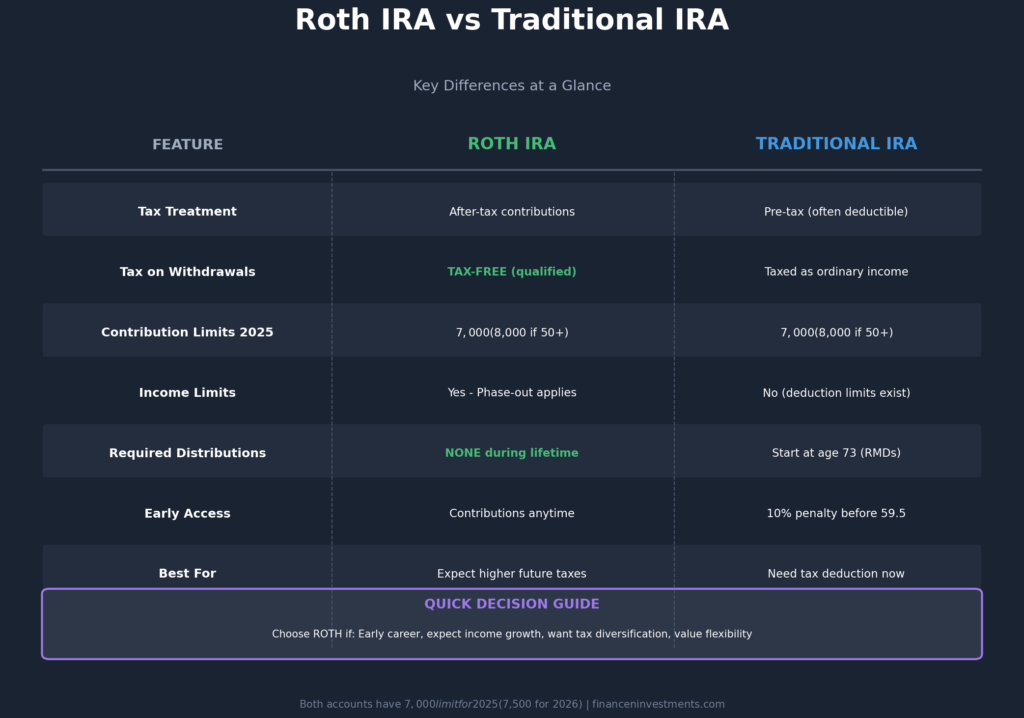
The core distinction is timing: Traditional accounts defer taxes until withdrawal (tax you later), while Roth accounts tax contributions immediately (tax you now). This seemingly simple difference creates profound implications for wealth building.
Most investors misunderstand Roth IRAs by treating them as interchangeable with traditional IRAs. They’re not. The Roth’s value proposition depends entirely on your current versus future tax rate trajectory, your investment time horizon, and your need for contribution accessibility.
The psychology behind poor Roth IRA utilization often stems from short-term thinking. Investors instinctively prefer the immediate gratification of a tax deduction today over the delayed benefit of tax-free withdrawals decades later. Research from the Employee Benefit Research Institute shows that workers consistently underweight future tax liability when making retirement account decisions – a cognitive bias that favors traditional accounts even when Roth accounts would produce superior after-tax outcomes.
Consider the contrast between effective and ineffective Roth IRA approaches: An effective investor treats their Roth as a long-term tax-sheltering vehicle, filling it with high-growth investments that maximize tax-free compounding. An ineffective investor treats their Roth as a secondary savings account, leaving contributions in cash or overly conservative investments that waste the account’s primary benefit – unlimited tax-free growth.
Current market conditions make Roth IRAs particularly relevant. With federal debt levels at historic highs and expiring tax provisions scheduled for reassessment in coming years, many financial planners anticipate higher future tax rates. Locking in today’s rates through Roth contributions positions investors to benefit from this potential asymmetry.
The 5 Types of Roth IRA Strategies (Ranked by Tax Efficiency)
1. Direct Contribution (Highest Simplicity)
Direct contribution is the standard approach: contribute after-tax dollars up to the annual limit if your income falls below the threshold. This strategy requires minimal planning and paperwork, making it ideal for investors within income limits who want straightforward retirement savings.
Best for: Investors earning below phase-out limits ($150,000 single, $236,000 married filing jointly in 2025)
2. Backdoor Roth IRA (Highest Accessibility for High Earners)
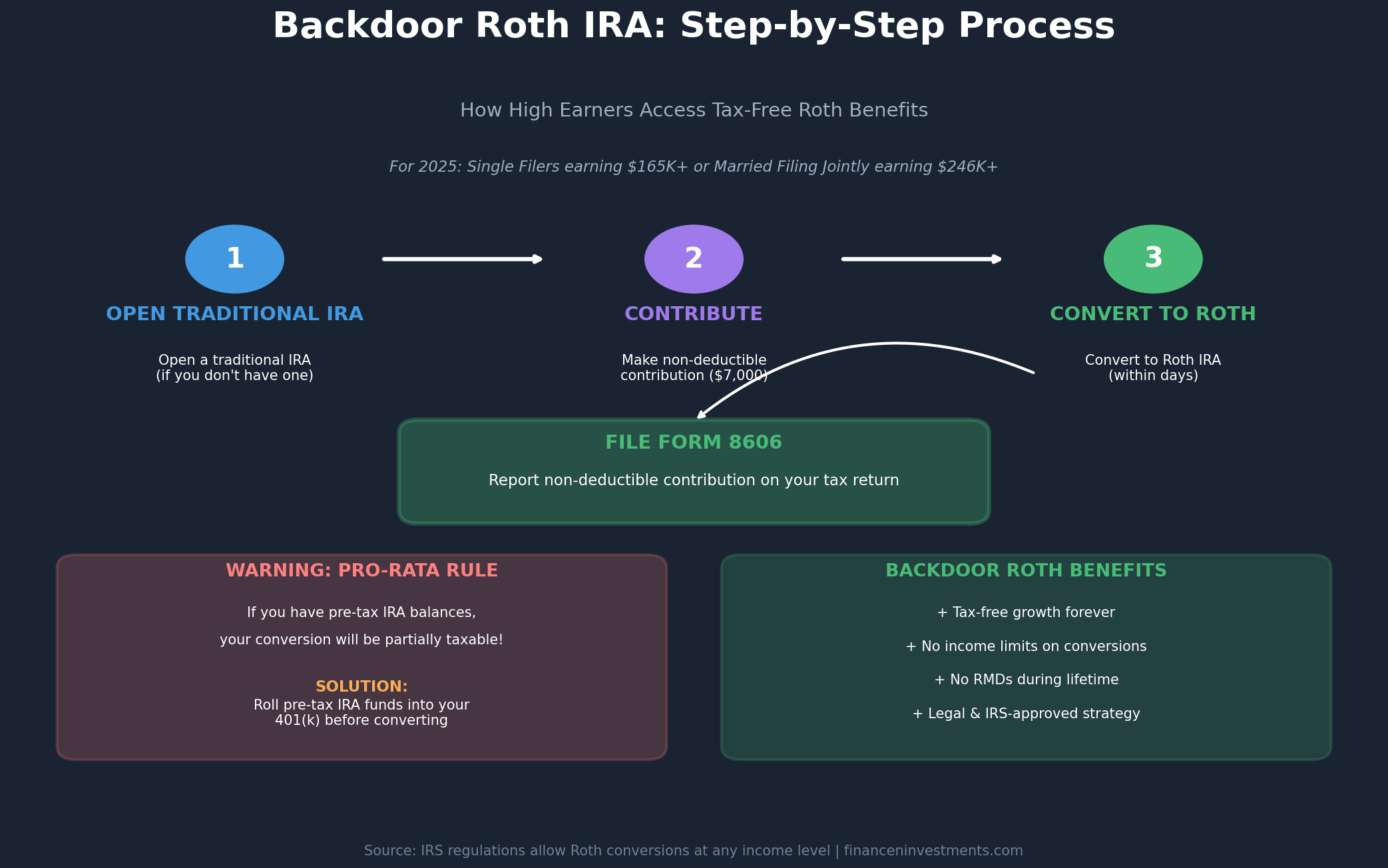
The backdoor Roth allows high-income earners to access Roth benefits by contributing to a traditional IRA (non-deductible) and immediately converting to a Roth IRA. Since no income limits exist for IRA conversions, this two-step process circumvents contribution restrictions.
Best for: Investors earning above direct contribution limits who want Roth’s tax-free growth
Critical consideration: The pro-rata rule requires that if you hold pre-tax IRA balances, a proportional amount of any conversion becomes taxable. Roll existing pre-tax IRA funds into a 401(k) before executing this strategy.
3. Mega Backdoor Roth (Highest Contribution Potential)
Some employer 401(k) plans allow after-tax contributions beyond the standard deferral limit. These after-tax funds can then be converted to Roth – either within the plan (Roth 401(k)) or to an external Roth IRA. This strategy can shelter an additional $46,500 or more annually.
Best for: High earners with compatible employer plans seeking maximum Roth accumulation
4. Roth Conversion (Highest Strategic Flexibility)
Converting existing traditional IRA or 401(k) funds to Roth IRA triggers immediate taxation but enables future tax-free growth. Strategic conversions during low-income years – career transitions, market downturns, or early retirement – can reduce lifetime tax liability.
Best for: Investors with substantial traditional retirement balances anticipating higher future tax rates
5. Spousal Roth IRA (Highest Household Coverage)
A non-working spouse can contribute to their own Roth IRA based on the working spouse’s earned income when filing jointly. This effectively doubles household Roth capacity to $14,000 annually ($16,000 with catch-up contributions).
Best for: Single-income households seeking to maximize tax-advantaged retirement savings
The Financial Advantages of Roth IRAs: Real Returns and Outcomes
The Roth IRA’s benefits extend far beyond the headline advantage of tax-free withdrawals. Understanding the full spectrum of advantages reveals why financial planners consistently recommend Roth accounts for wealth building.
Tax-Free Compounding Quantified: The mathematical impact of tax-free growth compounds dramatically over time. Consider a $7,000 annual contribution over 30 years, earning 7% annually:
| Scenario | Final Value | Taxes Owed at Withdrawal (25% rate) | After-Tax Value |
|---|---|---|---|
| Roth IRA | $706,000 | $0 | $706,000 |
| Traditional IRA | $706,000 | $176,500 | $529,500 |
| Taxable Account | $583,000* | Variable | ~$530,000 |
*Reduced by annual dividend and capital gains taxes during accumulation
The Roth produces $176,500 more in after-tax retirement wealth from identical contributions – a 33% advantage stemming purely from tax treatment.
No Required Minimum Distributions: Unlike traditional IRAs and 401(k)s, Roth IRAs impose no required minimum distributions (RMDs) during the owner’s lifetime. This preserves investment flexibility, allows continued tax-free growth, and creates superior estate planning opportunities. A 73-year-old Roth IRA owner can leave their entire balance invested rather than taking mandatory withdrawals that might push them into higher tax brackets.
Contribution Accessibility: Roth IRA contributions (though not earnings) can be withdrawn at any time without taxes or penalties. This creates a financial backstop during emergencies while maintaining the account’s long-term retirement purpose. No other retirement account offers this combination of accessibility and tax efficiency.
Estate Planning Advantages: Inherited Roth IRAs generally pass to beneficiaries tax-free. While most non-spouse beneficiaries must deplete inherited accounts within 10 years under current rules, those withdrawals remain tax-free – a significant advantage over traditional IRAs, where inherited balances are fully taxable.
Tax Diversification in Retirement: Combining Roth and traditional retirement accounts provides withdrawal flexibility. Retirees can strategically draw from taxable accounts first, then traditional accounts up to the top of their desired tax bracket, then Roth accounts for additional needs – minimizing lifetime tax liability through intelligent sequencing.
Why Smart Investors Struggle with Roth IRAs (And How to Overcome It)
Despite their advantages, Roth IRAs present legitimate challenges that cause even sophisticated investors to underutilize these accounts.
Income Eligibility Complexity: The phase-out structure creates confusion. In 2025, single filers face reduced contribution limits between $150,000 and $165,000 MAGI; above $165,000, direct contributions are prohibited. Married couples filing jointly encounter phase-outs between $236,000 and $246,000. Calculating modified adjusted gross income – which differs from standard AGI – adds another layer of complexity.
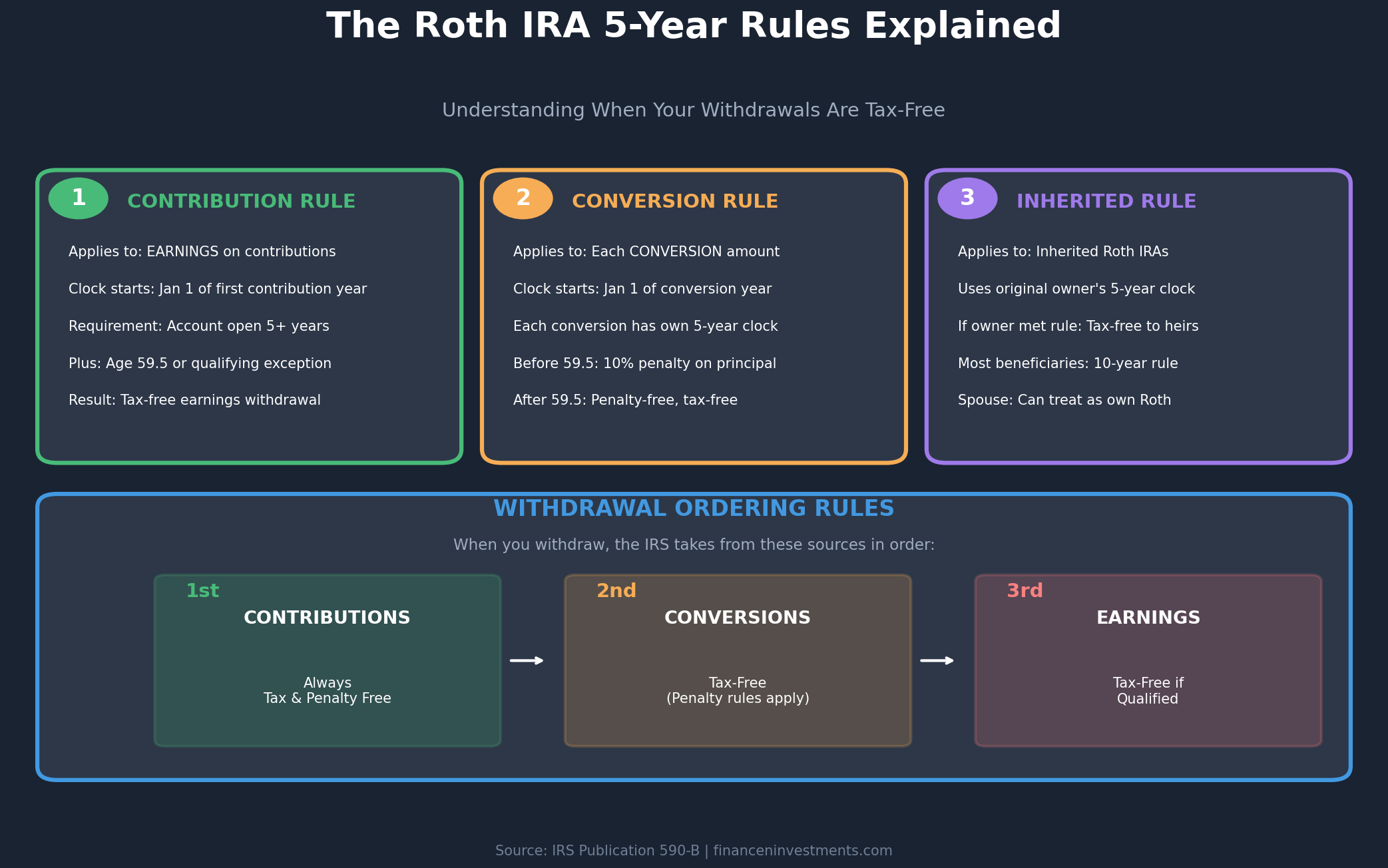
The Five-Year Rule Maze: Roth IRAs involve multiple five-year rules that govern withdrawal taxation:
- Contributions Rule: Earnings withdrawn before the account has been open five years are taxable (and may incur penalties before age 59½)
- Conversion Rule: Each conversion has its own five-year clock for penalty-free withdrawal of converted amounts before age 59½
- Inherited Roth Rule: Beneficiaries must consider whether the original owner satisfied the five-year requirement
Misunderstanding these rules leads to unexpected tax bills. The key insight: these rules primarily affect early withdrawals. Investors who maintain their Roth until age 59½ with accounts older than five years face no restrictions.
Analysis Paralysis on Roth vs. Traditional: The Roth-versus-traditional decision involves projecting future tax rates – an inherently uncertain exercise. Many investors become paralyzed by this uncertainty, delaying contributions entirely. The practical solution: contribute to Roth during lower-earning years (early career, sabbaticals, early retirement) and emphasize traditional accounts during peak earning years.
Underinvestment Within the Account: Many Roth IRA holders leave contributions in money market funds or excessively conservative investments, wasting the account’s primary value proposition. A Roth IRA invested in cash earning 4% wastes the tax-free growth benefit that makes these accounts valuable – growth investments generate the gains that would otherwise be taxed.
Procrastination on Conversions: The optimal time for Roth conversions is often during market downturns (converting depressed assets produces lower tax bills) or low-income years. These opportunities are time-sensitive and emotionally challenging – converting during bear markets means paying taxes while watching your portfolio decline. The logical investor recognizes this as precisely the right time to act.
Step-by-Step Framework for Roth IRA Success
Step 1: Determine Your Eligibility (5 minutes)
Calculate your modified adjusted gross income (MAGI) for the current tax year:
- Start with your adjusted gross income (Form 1040, line 11)
- Add back: student loan interest deduction, tuition deductions, IRA contribution deduction, foreign earned income exclusion
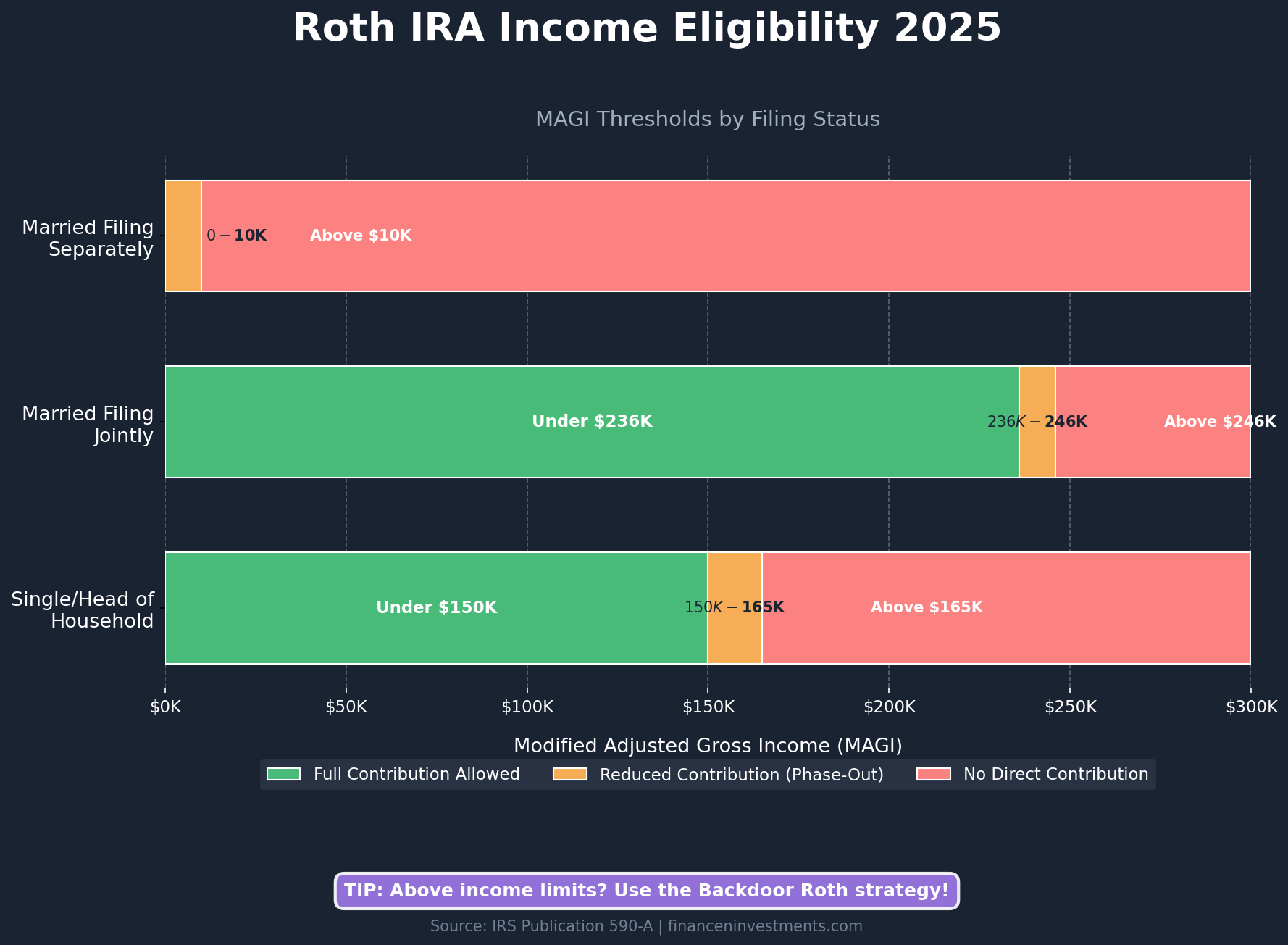
2025 Contribution Limits by Income:
| Filing Status | Full Contribution | Reduced Contribution | No Direct Contribution |
|---|---|---|---|
| Single/Head of Household | Under $150,000 | $150,000–$165,000 | Above $165,000 |
| Married Filing Jointly | Under $236,000 | $236,000–$246,000 | Above $246,000 |
| Married Filing Separately | N/A | $0–$10,000 | Above $10,000 |
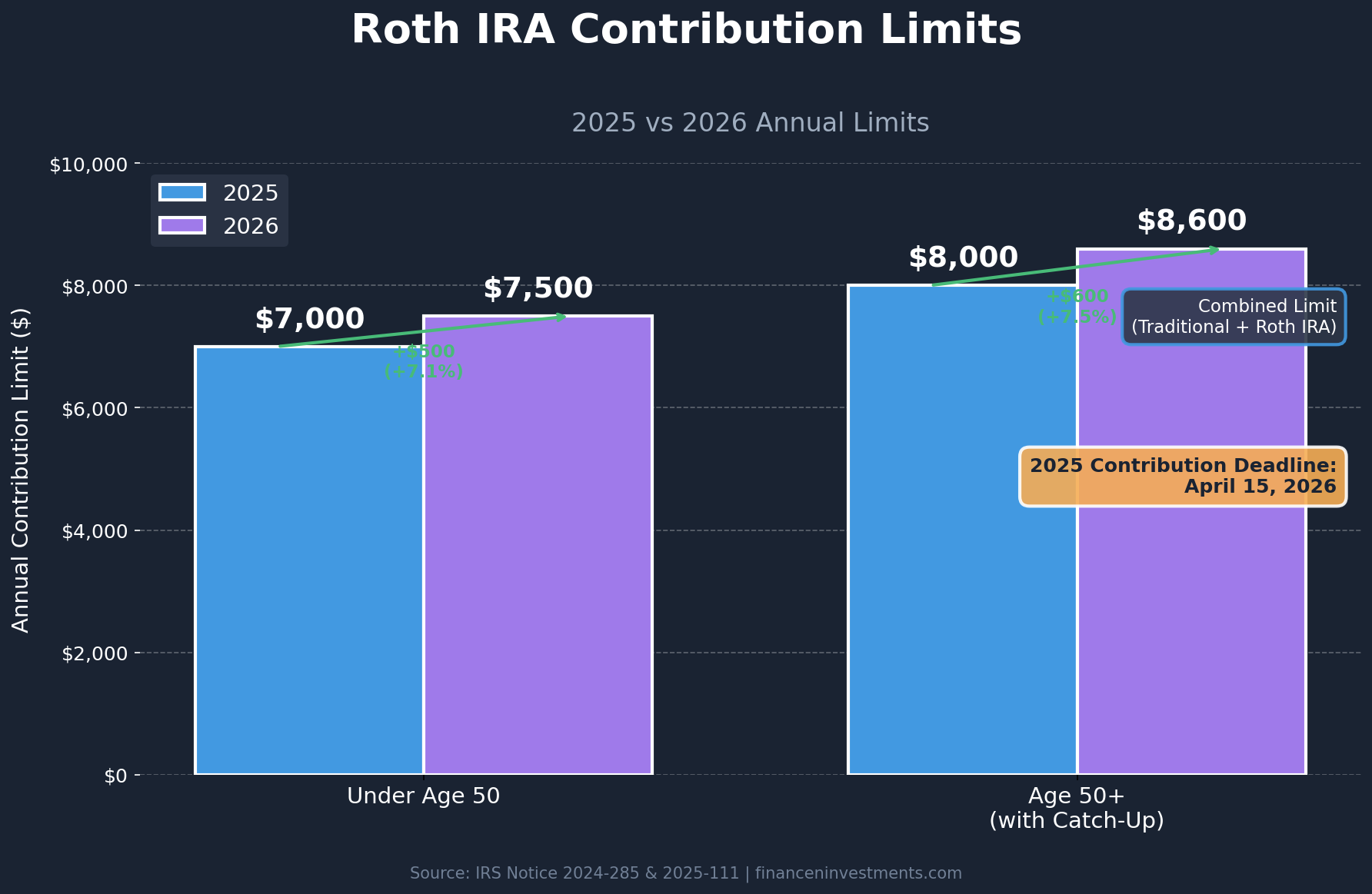
2025 Contribution Limits: $7,000 (under age 50) or $8,000 (age 50 and older)
2026 Contribution Limits: $7,500 (under age 50) or $8,600 (age 50 and older)
Step 2: Select Your Brokerage (15–30 minutes)
The three dominant Roth IRA providers – Vanguard, Fidelity, and Charles Schwab – each offer compelling advantages:
| Feature | Vanguard | Fidelity | Charles Schwab |
|---|---|---|---|
| Account Minimum | $0 (most accounts) | $0 | $0 |
| Stock/ETF Commissions | $0 | $0 | $0 |
| Index Fund Expense Ratios | 0.03%–0.15% | 0.00%–0.15% | 0.03%–0.08% |
| Proprietary Index Funds | Excellent | Excellent (includes Zero funds) | Excellent |
| Customer Service | Phone/chat | Phone/chat + 200+ branches | Phone/chat + 400+ branches |
| Robo-Advisor Option | Digital Advisor (0.20% fee) | Fidelity Go (0.35% over $25k) | Intelligent Portfolios (free basic) |
Decision framework: Choose Fidelity for zero-expense-ratio funds and robust education resources. Choose Schwab for the largest branch network and seamless backdoor Roth execution. Choose Vanguard for lowest-cost target-date funds and investor-owned structure.
Step 3: Open Your Account (10–15 minutes)
Required information:
- Social Security number
- Employment information (employer name/address)
- Bank account for funding (routing and account numbers)
- Beneficiary designation (name, date of birth, Social Security number)
Most providers allow online account opening with immediate access to funds and investments.
Step 4: Fund Your Account
Options for initial funding:
- Electronic bank transfer (1–3 business days, no fees)
- Wire transfer (same-day, potential fee)
- Check deposit (mobile or mail)
- Rollover from another IRA (direct transfer preferred)
Contribution deadline: You can contribute to your 2025 Roth IRA until April 15, 2026. However, contributing early maximizes compounding time – contributing $7,000 on January 1 versus April 15 of the following year gains an extra 15+ months of potential growth.
Step 5: Select Your Investments
For Hands-Off Investors: Target-date funds provide complete diversification in a single investment. Select the fund with the year closest to your expected retirement (e.g., Target 2050 fund for someone retiring around 2050). These funds automatically adjust from growth-oriented to conservative allocations as you age.
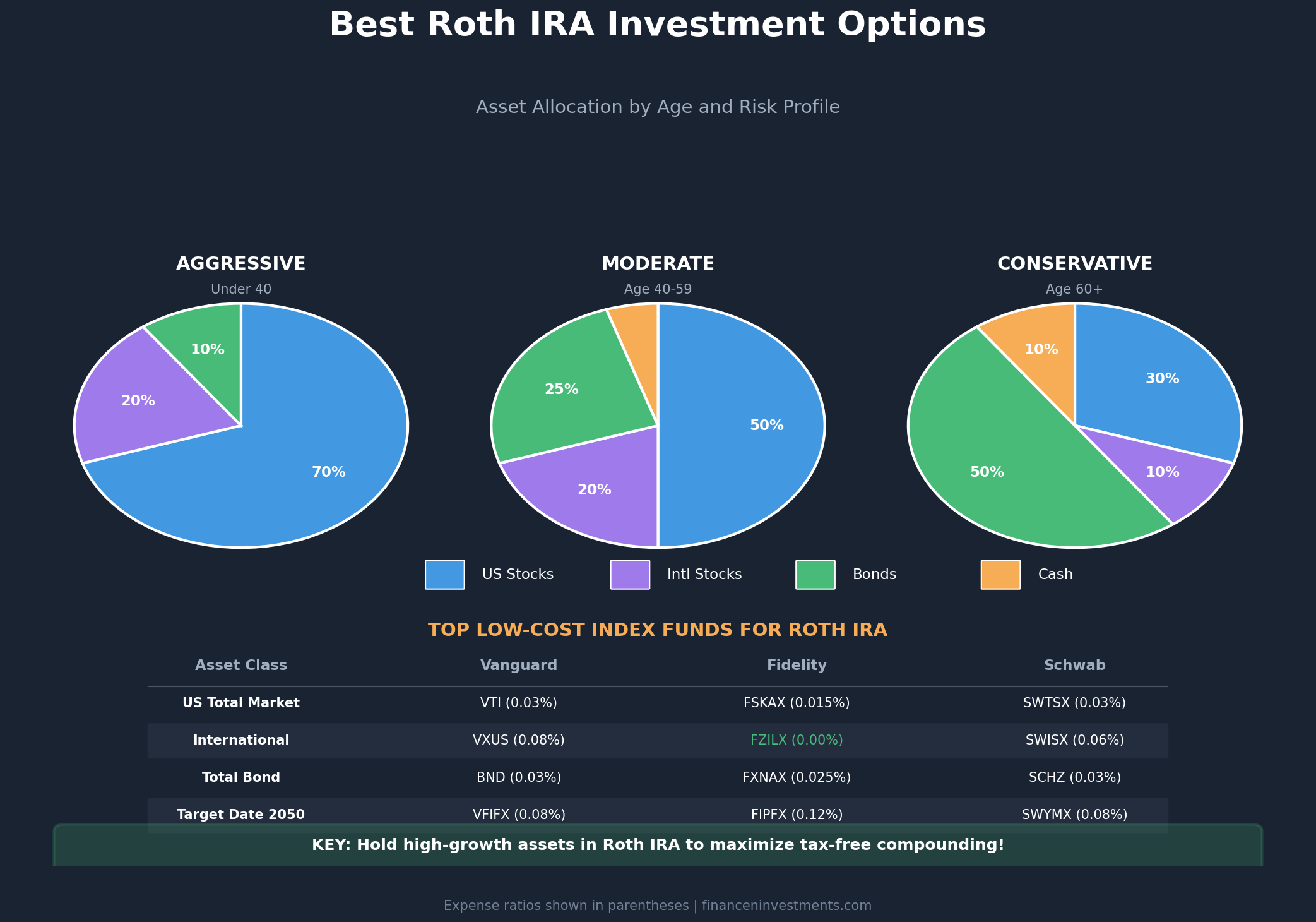
For DIY Investors: Build a diversified portfolio using low-cost index funds or ETFs:
| Allocation Type | Conservative (Age 60+) | Moderate (Age 40–59) | Aggressive (Under 40) |
|---|---|---|---|
| U.S. Stocks | 30% | 50% | 70% |
| International Stocks | 10% | 20% | 20% |
| Bonds | 50% | 25% | 10% |
| Cash/Money Market | 10% | 5% | 0% |
Recommended low-cost funds:
- U.S. Total Stock Market: VTI (Vanguard), FSKAX (Fidelity), SWTSX (Schwab)
- International Stocks: VXUS (Vanguard), FZILX (Fidelity), SWISX (Schwab)
- Total Bond Market: BND (Vanguard), FXNAX (Fidelity), SCHZ (Schwab)
Step 6: Automate and Monitor
Set up automatic monthly contributions to systematize saving. Most providers allow automatic investments into your selected funds. Review your allocation annually and rebalance if any asset class drifts more than 5% from target.
Roth IRA Withdrawal Rules: What You Can Access and When
Understanding withdrawal rules prevents costly mistakes and unlocks the Roth IRA’s full flexibility.
Contributions: Always Accessible. Your original contributions can be withdrawn at any time, for any reason, without taxes or penalties. This is Roth’s unique advantage – no other retirement account offers unrestricted access to contributed funds.
Qualified Distributions: Completely Tax-Free. To withdraw earnings tax-free and penalty-free, distributions must be “qualified,” requiring:
- Account open for at least five tax years (starting January 1 of the year of your first contribution)
- AND one of: age 59½ or older, permanent disability, distribution to beneficiary after death, or first-time home purchase (up to $10,000 lifetime)
Non-Qualified Distributions: Understanding the Consequences. Withdrawing earnings before meeting qualified distribution requirements triggers:
- Income tax on the earnings portion
- 10% early withdrawal penalty (if under age 59½)
Penalty Exceptions (avoid 10% penalty, but earnings remain taxable):
- First-time home purchase (up to $10,000)
- Qualified education expenses
- Unreimbursed medical expenses exceeding 7.5% of AGI
- Health insurance premiums during unemployment
- Birth or adoption expenses (up to $5,000)
- Substantially equal periodic payments (72(t) distributions)
The Ordering Rules: Your Safety Net When you withdraw from a Roth IRA, the IRS treats distributions in this order:
- Regular contributions (always tax and penalty-free)
- Conversion contributions (tax-free, but may face a penalty if within a five-year conversion window and under 59½)
- Earnings (subject to taxes and potential penalties if non-qualified)
This ordering means that most early withdrawals affect only contributions, avoiding tax consequences entirely.
The Future of Roth IRAs: What’s Coming Next
The Roth IRA landscape continues to evolve amid regulatory changes, market developments, and shifting tax policy. Positioning for these changes enhances long-term outcomes.
SECURE 2.0 Implementation: Recent legislation expanded Roth options within employer plans and modified catch-up contribution rules. Beginning in 2026, employees earning over $150,000 in FICA wages must make catch-up contributions on a Roth (after-tax) basis only. This regulatory shift further emphasizes Roth’s growing role in retirement planning.
Tax Rate Uncertainty: Current tax rates under the Tax Cuts and Jobs Act provisions face potential changes in coming years. Many financial planners anticipate higher marginal rates as policymakers address fiscal challenges. This environment favors Roth contributions – locking in current tax rates shields future withdrawals from potential increases.
Technology Integration: Digital platforms increasingly simplify Roth IRA management. Automated rebalancing, tax-loss harvesting integration, and AI-powered contribution optimization help investors maximize their accounts without active management. The democratization of sophisticated strategies formerly available only to high-net-worth clients benefits all Roth IRA holders.
Backdoor Roth Scrutiny: While the backdoor Roth strategy remains fully legal, Congressional attention on high-income retirement strategies suggests potential future restrictions. Investors currently above income limits should consider executing backdoor contributions while the opportunity exists, rather than waiting for potential legislative changes.
Roth IRA Guide: Your Most Important Questions Answered
1. How much should I contribute to my Roth IRA this year? Contribute the maximum allowed ($7,000 for 2025, $8,000 if 50+) if your budget allows. If you can’t max out, contribute what you can – even $200 monthly adds up to $72,000 over 30 years before investment growth.
2. Can I contribute to both a Roth IRA and a 401(k)? Yes. The contribution limits are separate. You can contribute up to $23,500 to your 401(k) in 2025 AND up to $7,000 to your Roth IRA, assuming you meet income requirements.
3. What happens if I contribute more than the limit? Excess contributions incur a 6% penalty annually until removed. You have until your tax filing deadline (plus extensions) to withdraw excess contributions and avoid the penalty for that tax year.
4. Should I choose Roth or Traditional IRA? Choose Roth if you expect higher tax rates in retirement, want tax diversification, value contribution accessibility, or are early in your career. Choose Traditional if you need the immediate tax deduction and expect significantly lower retirement tax rates.
5. How do I execute a backdoor Roth IRA? Open a traditional IRA, make a non-deductible contribution, then convert to Roth (usually within days to minimize taxable gains). File Form 8606 with your tax return documenting the non-deductible contribution. Ensure you have no pre-tax IRA balances to avoid pro-rata taxation.
6. What’s the best investment for a Roth IRA? High-growth investments maximize the Roth’s tax-free compounding benefit. A low-cost total stock market index fund or target-date fund serves most investors well. Avoid holding cash or ultra-conservative investments that waste the account’s growth potential.
7. When can I withdraw from my Roth IRA penalty-free? Contributions: anytime. Conversions: after five years or age 59½. Earnings: after five years AND age 59½ (or qualifying exception). Multiple penalty exceptions exist for specific circumstances, even before these thresholds.
8. Do Roth IRAs have required minimum distributions? No. Unlike Traditional IRAs and 401(k)s, Roth IRAs impose no RMDs during the owner’s lifetime. You can leave funds invested indefinitely, allowing continued tax-free growth.
9. Can I have multiple Roth IRAs? Yes. However, your total contributions across all Roth IRAs cannot exceed the annual limit. Having multiple accounts may complicate tracking, but doesn’t change contribution or withdrawal rules.
10. What happens to my Roth IRA when I die? Your Roth IRA transfers to designated beneficiaries. Most non-spouse beneficiaries must withdraw all funds within 10 years but pay no taxes on qualified distributions. Spouse beneficiaries have additional options, including treating the inherited Roth as their own.
Conclusion – Roth IRA Guide: Your Path to Tax-Free Retirement Wealth
The Roth IRA represents a rare opportunity in the tax code: a vehicle for completely tax-free investment growth and retirement income. In an era of uncertain future tax rates and increasing fiscal pressures, securing tax-free income streams provides both financial and psychological benefits that compound over time.
The cost of inaction is substantial. Every year without Roth contributions forfeits irreplaceable compounding time. A 30-year-old who delays starting their Roth IRA by just five years sacrifices approximately $150,000 in final account value – not from missed contributions, but from lost compounding on those early contributions.
Whether you’re opening your first Roth IRA or optimizing an existing account, the steps are clear: verify your eligibility, select a low-cost provider, fund your account consistently, invest in growth-oriented assets, and let tax-free compounding work in your favor. For high earners above income limits, the backdoor Roth strategy extends these benefits to virtually everyone willing to execute a straightforward two-step process.
Your immediate next step: Open a Roth IRA today at Vanguard, Fidelity, or Schwab – or make your 2025 contribution if you already have an account. The April 15, 2026, deadline for 2025 contributions approaches faster than you think, but the real deadline is today: every day without invested contributions is a day of tax-free growth you’ll never recover.
Good luck with your future investments!
Didi Somm & Team
Recently published articles include:
- The 3-Fund Portfolio: A Complete Guide to Simple, Powerful Investing
- Value vs Growth Investing: Which Strategy Wins in 2026?
- Active vs Passive Investing – Your Best Guide
- Expense Ratios: Why Fees Matter
- Dollar-Cost Averaging Explained: The Simple Strategy That Removes Emotion from Investing
- What Are Dividend Stocks – The Ultimate Income Guide
- What Is Diversification?
Disclaimer: This article is for educational purposes only and is not financial advice. Investing involves risk, including potential loss of principal. Consider consulting a financial advisor for personalized advice. Past performance does not guarantee future results. All dollar amounts and projections are illustrative examples only. Tax situations vary – consult a tax professional for specific guidance