
When three of the world’s largest brokerages all charge zero commissions, zero account minimums, and near-zero expense ratios, how do you choose between them? The answer, after 30 years in banking, is that you stop looking at the headline numbers and start looking at the ones they don’t put on the homepage.
The real Fidelity vs Schwab vs Vanguard decision in 2026 comes down to four things: what you pay on uninvested cash (this is where Schwab gets you), which index funds you want, whether you mind being locked in, what kind of investor you are, and whether you ever need to talk to a human. I have broken down each dimension honestly below – including the number that most comparison articles skip entirely.
Welcome to Didi Somm & Team
Disclaimer: This article is for educational purposes only and is not financial, tax, or investment advice. Fee and rate information reflects publicly available data as of 2026 and is subject to change. Always verify current rates and terms directly with the relevant institution before making decisions.
KEY TAKEAWAYS
- All three charge $0 commissions on stock and ETF trades — the headline fee war is over
- The biggest hidden cost difference is cash sweep rates: Fidelity pays 3.29%, Schwab pays just 0.05% — a $3,240/year gap on $100,000 of idle cash
- Fidelity wins on index fund expense ratios with its zero-fee FZROX (0.00%) — but those funds cannot be transferred to another broker
- Vanguard’s investor-owned structure uniquely aligns its incentives with yours — but its platform lags behind
- Schwab wins for active traders who want the thinkorswim platform and branch access
Table of Contents
Why the fee war is mostly over — and what still matters
In 2019, every major US broker dropped stock and ETF trading commissions to zero. The fee war ended, and a different question emerged: if commissions are gone, how do these companies make money? The answer shapes everything about how they treat your cash.
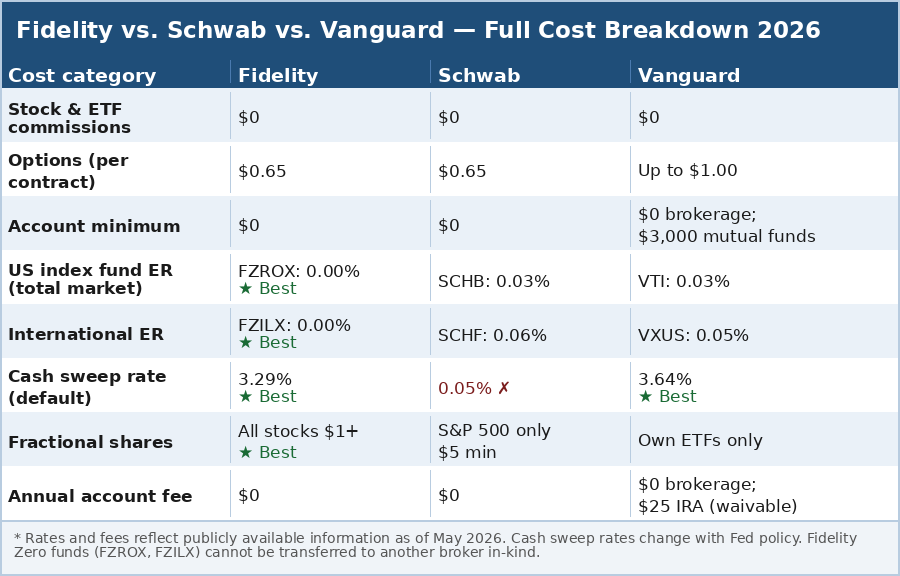
Schwab earns most of its revenue from the spread on uninvested cash – sweeping your idle money into its own bank at a low rate and keeping the difference. As of 2026, Schwab’s default cash sweep pays 0.05% annually. Fidelity’s core money market position pays 3.29%. Vanguard’s settlement fund pays 3.64%. On $100,000 of idle cash, that is the difference between earning $50 a year and $3,640. This single number – the cash sweep rate – is the most important hidden cost in the Fidelity vs Schwab vs Vanguard comparison, and most investors never check it.
Index fund expense ratios: where Fidelity wins — with a catch
For a buy-and-hold index fund investor, expense ratios are the primary ongoing cost. Here is how the three compare on the most important funds:
US total market: Fidelity FZROX charges 0.00%, Vanguard VTI charges 0.03%, Schwab SCHB charges 0.03%. The gap between Fidelity and the other two is 3 basis points – $30 per year on $100,000. Not nothing, but not a decision-maker.
International equity: Vanguard VXUS charges 0.05%, Fidelity FZILX charges 0.00%, Schwab SCHF charges 0.06%. For investors with heavy international exposure, this gap is more meaningful.
Bonds: Vanguard BND charges 0.03%, Fidelity FXNAX charges 0.025%, and Schwab SCHZ charges 0.03%. Near identical.
The critical caveat about Fidelity’s zero-fee funds: FZROX, FZILX, and other Fidelity Zero funds are proprietary and cannot be transferred in kind to another brokerage. If you ever want to move your account, you must sell it first – which could trigger a taxable event. For investors committed to staying at Fidelity, this is irrelevant. For everyone else, the 0.03% difference may not be worth the lock-in.
Trading fees and account features: where they differ
Options trading: Fidelity and Schwab both charge $0.65 per contract. Vanguard charges up to $1 per contract and is clearly the weakest option for options traders.
Fractional shares: Fidelity offers $1 fractional shares on all stocks and ETFs – the most flexible in the group. Schwab offers fractional shares on S&P 500 stocks only with a $5 minimum. Vanguard offers fractional shares on its own ETFs only – a significant limitation for investors starting with small amounts.
Account minimums: All three have $0 minimums for brokerage accounts. Vanguard’s most popular mutual funds (VTSAX, VTIAX) require a $3,000 minimum – a genuine barrier for beginners that Fidelity and Schwab do not impose.
Research and tools: Fidelity offers the most comprehensive research platform, with data from Argus, Zacks, CFRA, and S&P Global. Schwab’s thinkorswim is the best active trading platform available at any US broker. Vanguard’s platform is functional but dated – it is designed for the set-it-and-forget-it investor who checks their account quarterly.
Customer service: Fidelity offers 24/7 support via phone, chat, and email. Schwab has an extensive physical branch network – the largest of the three – which matters to investors who prefer face-to-face service. Vanguard’s customer service is phone-only, Monday to Friday, 8am to 8pm Eastern.
FAQ – Fidelity vs Schwab vs Vanguard
Which is better in 2026 — Fidelity, Schwab, or Vanguard?
For most investors, Fidelity is the best overall choice in 2026 — zero-fee index funds, best research, 24/7 service, and the highest cash rate among the three. Vanguard suits committed buy-and-hold investors; Schwab suits active traders and those who value branch access.
Do Fidelity, Schwab, and Vanguard all charge zero commissions?
Yes. All three charge $0 commissions on stock and ETF trades. The meaningful cost differences lie in cash sweep rates, options fees, and fund expense ratios.
What is the cash sweep rate difference between Fidelity, Schwab, and Vanguard?
As of 2026, Fidelity’s core position pays approximately 3.29%, Vanguard’s settlement fund pays approximately 3.64%, and Schwab’s default cash sweep pays just 0.05%. On $100,000 of idle cash, that is a $3,290 annual difference between Fidelity and Schwab.
Which broker has the lowest expense ratios?
Fidelity wins with its Zero funds (FZROX at 0.00%), but those funds cannot be transferred to another broker. Vanguard and Schwab both offer index ETFs at 0.03% — effectively negligible for most investors.
Can I transfer Fidelity Zero funds to another broker?
No. FZROX, FZILX, and other Fidelity Zero funds are proprietary and cannot be transferred in-kind. Moving to another broker requires selling them first, which may trigger capital gains tax.
Which broker is best for beginners?
Fidelity. No account minimum, $1 fractional shares on all stocks and ETFs, zero-fee index funds, and 24/7 customer support make it the most accessible and lowest-friction starting point in 2026.
Is Vanguard still worth using in 2026?
Yes, for the right investor. Vanguard’s investor-owned structure keeps costs low and aligns its interests with investors. Its main weaknesses are a dated platform, no fractional individual stocks, and $3,000 mutual fund minimums. If you already have a large Vanguard position, do not switch — the transaction costs and potential taxes outweigh any marginal benefit.
What is thinkorswim and why does it matter?
Thinkorswim is Schwab’s active trading platform, widely considered the most powerful retail trading interface available at any US broker. It matters primarily to options traders, frequent stock traders, and technical analysts — not to long-term buy-and-hold investors.
Which broker is best for retirement accounts (IRA, 401k)?
Fidelity and Vanguard are the two most-used brokers for retirement accounts among long-term investors. Fidelity’s zero-fee funds and strong IRA tools give it a slight edge for new accounts. Vanguard’s fund lineup and ownership structure make it an equally strong choice.
Does Schwab have physical branches?
Schwab has the largest physical branch network of the three — a meaningful advantage for investors who prefer face-to-face service or need in-person assistance.
What happens to my money if one of these brokers fails?
All three are SIPC-insured up to $500,000 per account ($250,000 for cash). Additionally, all three carry excess SIPC coverage through private insurers. In practice, broker failures at this scale are handled through asset transfers rather than liquidation—your securities are held separately from the broker’s assets.
Should I switch from Vanguard or Schwab to Fidelity?
Only if you are starting fresh or have a compelling, specific reason. For existing investors with established positions, the transaction costs, potential capital gains, and administrative friction of switching typically outweigh the marginal benefits. Fix the cash sweep at Schwab; leave Vanguard positions alone.
The verdict: which broker wins for whom
After reviewing every material dimension, this is my honest assessment from three decades of watching how financial institutions actually behave:
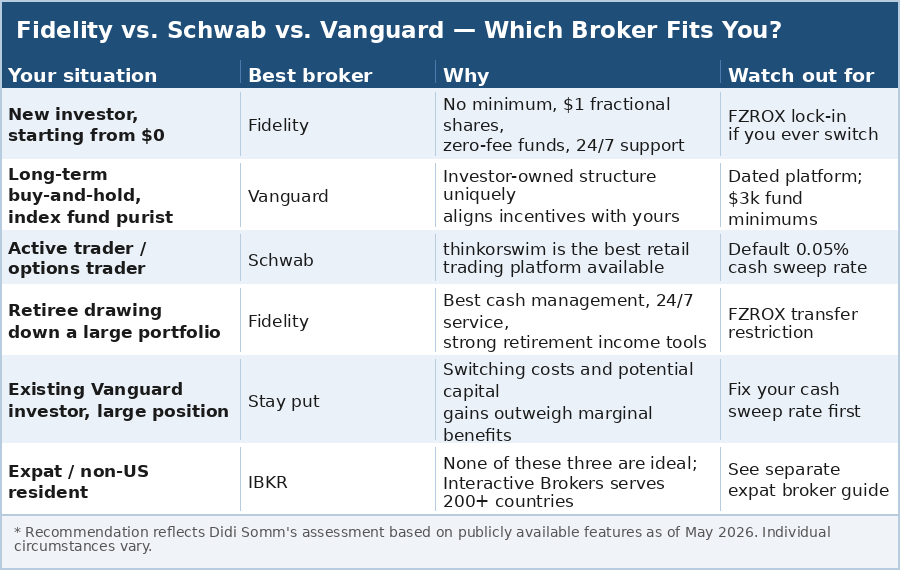
Choose Fidelity if you want the best all-around platform in 2026. Zero-fee index funds, best research tools, 24/7 service, fractional shares on everything, and the highest cash sweep rate among the three make it the default best choice for most investors — from beginners to retirees.
Choose Vanguard if you are a committed long-term buy-and-hold investor who wants to own Vanguard’s legendary funds (VTSAX, VTIAX) directly and cares about the investor-owned structure that uniquely aligns Vanguard’s incentives with yours. Accept the dated platform as the price of admission.
Choose Schwab if you are an active trader who wants thinkorswim, or if you value physical branch access and strong in-person customer service. Fix the cash sweep rate immediately by moving idle cash to a Schwab money market fund — do not leave it in the default sweep account.
The honest summary: for a new investor starting today, open at Fidelity. For an existing Vanguard investor with a large, established position – do not switch. The friction and potential tax cost of moving outweigh the marginal differences. Fix your cash sweep and move on.
Good luck with your investments!
Didi Somm & Team
Recently published articles include:
- ChatGPT Portfolio Management: 30 Days, 5 Tests, 2 Failures
- 401k Contribution Limits 2026: The Complete Optimization Guide
- BACKDOOR ROTH IRA – All You Need To Know in 2026
- Roth IRA Guide: Your Roadmap to Tax-Free Retirement Wealth
- The 3-Fund Portfolio: A Complete Guide to Simple, Powerful Investing
- Value vs Growth Investing: Which Strategy Wins in 2026?
- Active vs Passive Investing – Your Best Guide
- Expense Ratios: Why Fees Matter
About the author
Didi Somm spent 30+ years in international banking and commerce. He also runs dorealadvice.com, a business-intelligence platform. He writes here about building wealth with clarity and discipline.
Disclaimer: This article is for educational purposes only and is not financial, tax, or investment advice. Fee and rate information reflects publicly available data as of 2026 and is subject to change. Always verify current rates and terms directly with the relevant institution before making decisions.