
I have spent more than 30 years in international banking and commerce across markets, including Zurich, Singapore, New York, and Tokyo. I have seen technology reshape finance in waves: The arrival of electronic trading, the rise of robo-advisors, and the explosion of ETFs. Each time, the question was the same: Does this replace the human, or does it make the human better?
When ChatGPT became capable of having a coherent conversation about portfolio construction, I decided to find out for myself. For 30 days in early 2026, I used ChatGPT portfolio management as a genuine tool for my own investment thinking – not as a toy, but as a serious second opinion alongside my existing process. What I found was more nuanced than either the hype or the backlash suggested.
Welcome to Didi Somm & Team
Disclaimer: This article is for educational purposes only and is not financial, tax, or investment advice. Investing involves risk, including possible loss of principal. Consult a qualified professional before making investment decisions.
KEY TAKEAWAYS
- ChatGPT can produce solid portfolio frameworks and asset allocation logic – but it cannot execute trades, access your accounts, or use real-time data without plugins
- It is a powerful research and second-opinion tool, not a replacement for a licensed fiduciary
- After 30 days, I found it most useful for stress-testing assumptions and drafting rebalancing plans – not for live market decisions
- The biggest risk is not bad advice – it is overconfident advice that sounds authoritative but uses stale data
- Used correctly, ChatGPT can save a retail investor $500–$2,000 per year in advisory fees on straightforward decisions
Table of Contents
What I actually tested — and how
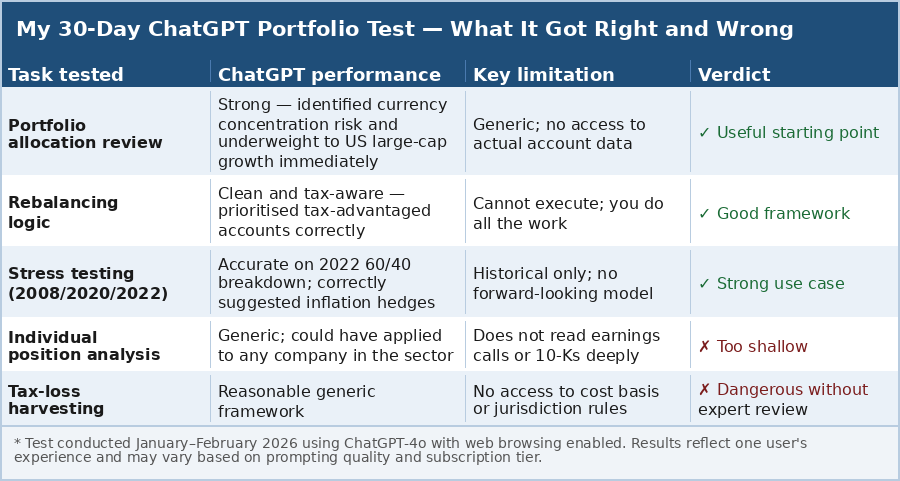
I did not hand ChatGPT my brokerage login and ask it to trade. That is not how the tool works, and anyone suggesting otherwise is either confused or selling something. What I did was use it systematically across five specific tasks over 30 days:
- Portfolio allocation review — I described my current allocation and asked for an objective critique.
- Rebalancing logic — I gave it a hypothetical drift scenario and asked for a rebalancing recommendation.
- Stress testing — I asked it to model how my allocation would have behaved in 2008, 2020, and 2022.
- Individual position analysis — I asked for a thesis on three specific holdings.
- Tax efficiency — I asked it to identify tax-loss harvesting opportunities given a set of hypothetical positions.
I used ChatGPT-4o with web browsing enabled throughout, which allowed it to access current data on some queries. I also tested the same prompts on Claude and Gemini for comparison, though ChatGPT was my primary subject.
What it got right
The allocation review was genuinely impressive. When I described a 65/30/5 equity-bond-cash allocation with a tilt toward European and Japanese equities, ChatGPT immediately identified the currency concentration risk, flagged the underweight to US large-cap growth (which has driven global returns for the past decade), and suggested rebalancing toward a more neutral global market-cap weighting. This was solid, mainstream advice – the kind a competent junior analyst at a private bank would produce.
The stress testing was equally useful. When I asked how a 60/40 portfolio would have behaved in 2022 – a year when both stocks and bonds fell simultaneously, breaking the traditional diversification assumption – ChatGPT gave an accurate, well-calibrated answer. It correctly noted that the 2022 correlation breakdown was unusual by historical standards and that a 60/40 portfolio lost approximately 16% that year. It suggested inflation-linked bonds and commodities as partial hedges. All of this was accurate and useful.
The rebalancing logic was clean and systematic. Given a drift scenario where equities had grown from 60% to 72% of a portfolio, it produced a clear, tax-aware rebalancing plan that prioritized selling in tax-advantaged accounts first. A good answer.
Where it struggled
Real-time data is the first and most important limitation. Even with web browsing enabled, ChatGPT’s access to current market data is inconsistent and sometimes wrong. On two occasions during my test, it quoted outdated fund expense ratios. On one occasion, it referenced a product that had been restructured. For anything requiring current pricing, live yield curves, or recent earnings data, you cannot trust it without independent verification.
The individual position analysis was the weakest area. When I asked for a thesis on a specific mid-cap holding, the response was generic and could have applied to any company in the sector. It lacked the specificity that comes from reading actual earnings calls, management commentary, and sell-side research. A good analyst reads the 10-K. ChatGPT summarises what is already widely written about a company, which is useful as a starting point, but not as investment research.
Tax efficiency was the most dangerous area. ChatGPT produced a reasonable framework for tax-loss harvesting, but it could not account for my specific cost basis, my other income, or my jurisdiction. The advice was generic, US-centric, and would have been actively wrong for a non-US investor or anyone with a complex tax situation. This is where the “sounds authoritative” risk is highest. The answer sounded like advice. It was not.
FAQ – ChatGPT Portfolio Management
Can ChatGPT manage my investment portfolio?
Not autonomously — it cannot access your brokerage account, execute trades, or monitor positions in real time. It can analyze portfolio logic, suggest allocation frameworks, and stress-test scenarios when you provide the data.
Is ChatGPT good for investment advice?
For general frameworks, educational explanations, and stress-testing allocation logic, yes. For specific stock picks, tax decisions, or anything requiring real-time data and personal context, treat its output as a starting point to verify rather than a final answer.
Does ChatGPT have access to real-time market data?
With web browsing enabled (ChatGPT Plus), it can access some current data, but coverage is inconsistent. It can quote stale prices and outdated fund information. Always verify current figures independently.
Can ChatGPT replace a financial advisor?
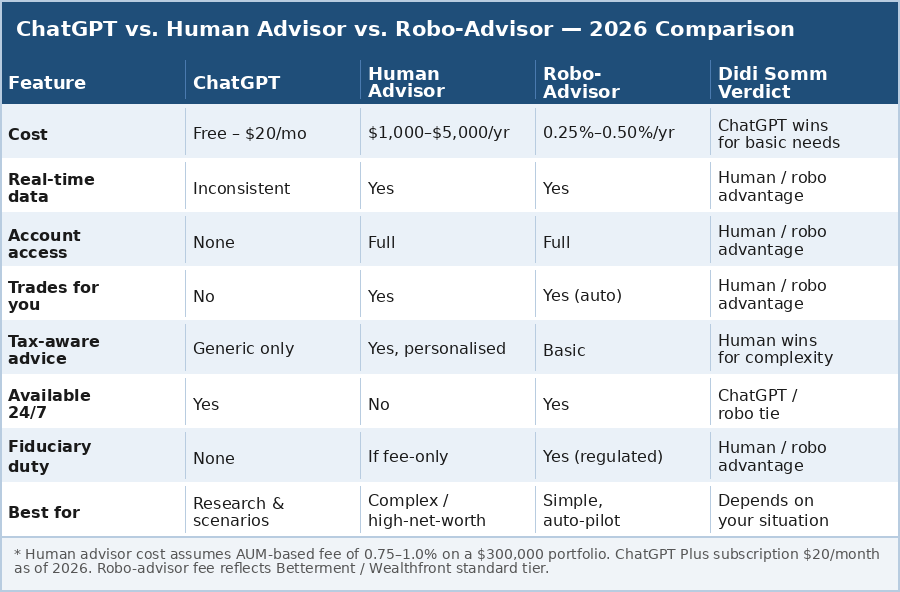
For investors with simple, straightforward portfolios — primarily index funds, standard asset allocation — it can handle many of the questions you might pay an advisor to answer. For complex situations involving taxes, estate planning, cross-border assets, or concentrated positions, a licensed fiduciary is irreplaceable.
What is ChatGPT best used for in investing?
Portfolio allocation review, rebalancing logic, stress-testing historical scenarios, explaining financial concepts, and drafting an agenda for a meeting with a real advisor. These are its strongest use cases.
What are the risks of using ChatGPT for financial decisions?
The main risks are presenting stale data confidently, offering generic advice that doesn’t account for your specific tax situation or jurisdiction, and lacking fiduciary accountability. It will not tell you when it does not know something.
How does ChatGPT compare to a robo-advisor?
A robo-advisor connects to your accounts, rebalances automatically, and is regulated. ChatGPT is unregulated, cannot access your accounts, and requires you to provide all the data. Robo-advisors act; ChatGPT advises.
Is ChatGPT better than a human financial advisor?
For speed and accessibility, yes. For accountability, personalization, real-time market access, and complex financial planning, no. The best outcome is using both — ChatGPT to research and prepare, and a human advisor for decisions that matter most.
What prompts work best for portfolio analysis with ChatGPT?
Be specific and provide all relevant context: your allocation, time horizon, risk tolerance, jurisdiction, and tax situation. The prompt “review my portfolio” produces generic output. The prompt “critique my 65/35 equity-bond allocation for a 55-year-old expat with Japanese and US assets, a 10-year horizon, and moderate risk tolerance” produces something genuinely useful.
Did you make money using ChatGPT for portfolio management?
My test was about decision quality, not returns over 30 days, which is far too short a period to measure anything meaningful. The portfolio decisions it informed were sound and consistent with my existing process. I did not take any actions I later regretted.
Can ChatGPT do tax-loss harvesting?
It can explain the concept and produce a generic framework. It cannot access your cost basis, knows nothing about your other income, and cannot account for jurisdiction-specific rules. Use it to understand the strategy; use a tax professional to execute it.
What is the difference between ChatGPT and a robo-advisor like Betterment or Wealthfront?
Robo-advisors are regulated investment advisors that manage your money automatically within pre-set parameters. ChatGPT is a language model that produces text. They are fundamentally different tools that happen to discuss the same subject.
The verdict after 30 days: a powerful assistant, not a portfolio manager
My conclusion after 30 days: ChatGPT is the best financial research assistant I have ever had access to, and it is not a portfolio manager.
The distinction matters. A research assistant helps you think. A portfolio manager is accountable for outcomes, understands your full financial picture, can execute, and carries a fiduciary duty. ChatGPT does the first. It does none of the second.
For a retail investor managing a straightforward index-fund portfolio, it is genuinely valuable. It can produce a rebalancing plan, explain any financial concept instantly, challenge your assumptions, and give you a second opinion at 2 a.m. at zero marginal cost. That is worth something – possibly $500–$2,000 per year in advisory fees avoided on simple, repeatable decisions.
For anyone with a complex situation – significant taxable gains, cross-border assets, estate-planning considerations, a concentrated stock position – it is both a useful starting point and a dangerous endpoint. Use it to prepare for a conversation with a professional, not to replace one.
My own use going forward: I will continue to use it for allocation stress testing and concept clarification. I will not use it for tax decisions, position-specific research, or any decision where the quality of the answer depends on information it cannot reliably access.
Good luck with your investments!
Didi Somm & Team
Recently published articles include:
- 401k Contribution Limits 2026: The Complete Optimization Guide
- BACKDOOR ROTH IRA – All You Need To Know in 2026
- Roth IRA Guide: Your Roadmap to Tax-Free Retirement Wealth
- The 3-Fund Portfolio: A Complete Guide to Simple, Powerful Investing
- Value vs Growth Investing: Which Strategy Wins in 2026?
- Active vs Passive Investing – Your Best Guide
- Expense Ratios: Why Fees Matter
- Dollar-Cost Averaging Explained: The Simple Strategy That Removes Emotion from Investing
About the author
Didi Somm spent 30+ years in international banking and commerce before founding his own advisory practice. He also runs dorealadvice.com, a business-intelligence platform. He writes here about building wealth with clarity and discipline.
Disclaimer: This article is for educational purposes only and is not financial, tax, or investment advice. Investing involves risk, including possible loss of principal. Consult a qualified professional before making investment decisions.