

401k Contribution Limits 2026
The IRS just handed disciplined savers a bigger window to build tax-advantaged wealth. Here are all the numbers you need – and the system to make full use of them.
Most workers contributing to a 401(k) are leaving five-figure sums on the table every decade – not because they lack the income, but because no one showed them the architecture of the limits.
The IRS quietly raised the 2026 employee deferral ceiling by $1,000 – the largest single-year jump since 2023 – and introduced a new mandatory Roth catch-up rule that changes the tax calculus for every high-earner over fifty. If your contribution strategy still looks the same as it did in 2024, you’re not optimized.
This guide lays out every limit, every catch-up tier, and the exact framework for turning the 2026 rules into a compounding advantage.
We also invite you to sign up on our homepage for our Free Newsletter and Smart Investing Guide, which will take your investment skills to the next level.
Didi Somm & Team
Disclaimer: This article is for educational purposes only and is not financial advice. Investing involves risk, including potential loss of principal. Consider consulting a financial advisor for personalized advice. Past performance does not guarantee future results. All dollar amounts and projections are illustrative examples only. Tax situations vary – consult a tax professional for specific guidance
Key Takeaways
- The 2026 employee deferral limit is $24,500 – a $1,000 increase from 2025. Invested at a 7% annual return, that extra $1,000 per year compounds to roughly $17,400 over fifteen years. The compounding argument for maxing out is not abstract; it is arithmetic.
- Workers aged 60–63 now qualify for a “super catch-up” of $11,250 – versus the standard $8,000 catch-up for ages 50–59 and 64+. If you are in that four-year window, the combined limit reaches $35,750 per year: a brief, powerful opportunity that SECURE 2.0 created specifically for late-career earners.
- Employer-matched dollars do not count against your personal deferral limit – but they do count toward the combined $72,000 annual cap. Understanding this distinction determines whether a mega backdoor Roth strategy is available inside your plan and how much after-tax room remains.
Table of Contents
Disclaimer: This article is for informational and educational purposes only and does not constitute personalized tax, legal, or investment advice. Contribution limits and rules are based on IRS Notice 2025-67 and SECURE 2.0 provisions as understood at the time of publication. Individual circumstances vary. Consult a qualified tax professional or financial advisor before making contribution decisions.
What 401k Contribution Limits Really Mean (And Why Most Get It Wrong)
The term “401k contribution limits” is deceptively simple. In reality, the IRS operates three distinct ceilings simultaneously, and confusing them is the source of most optimization errors.
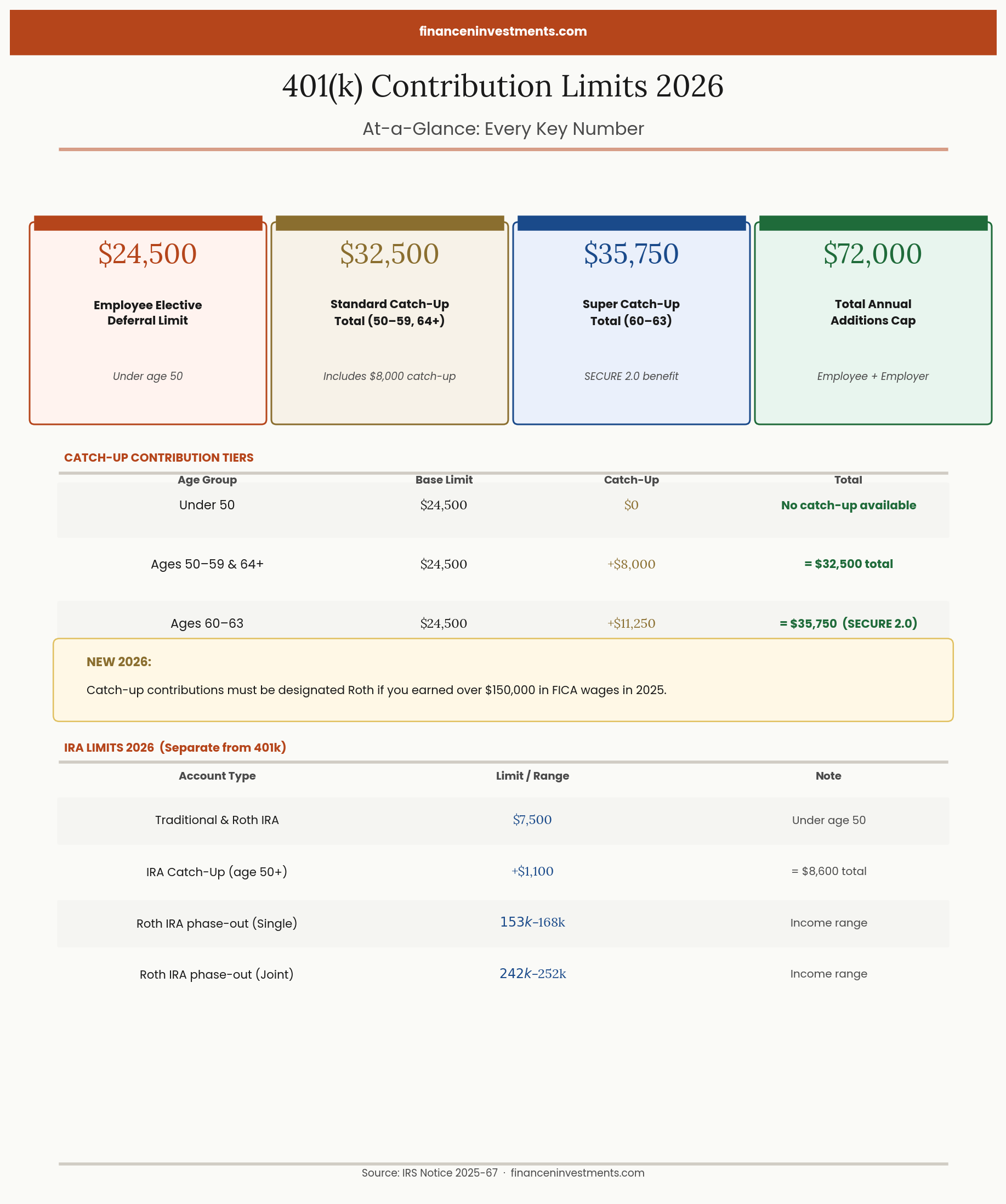
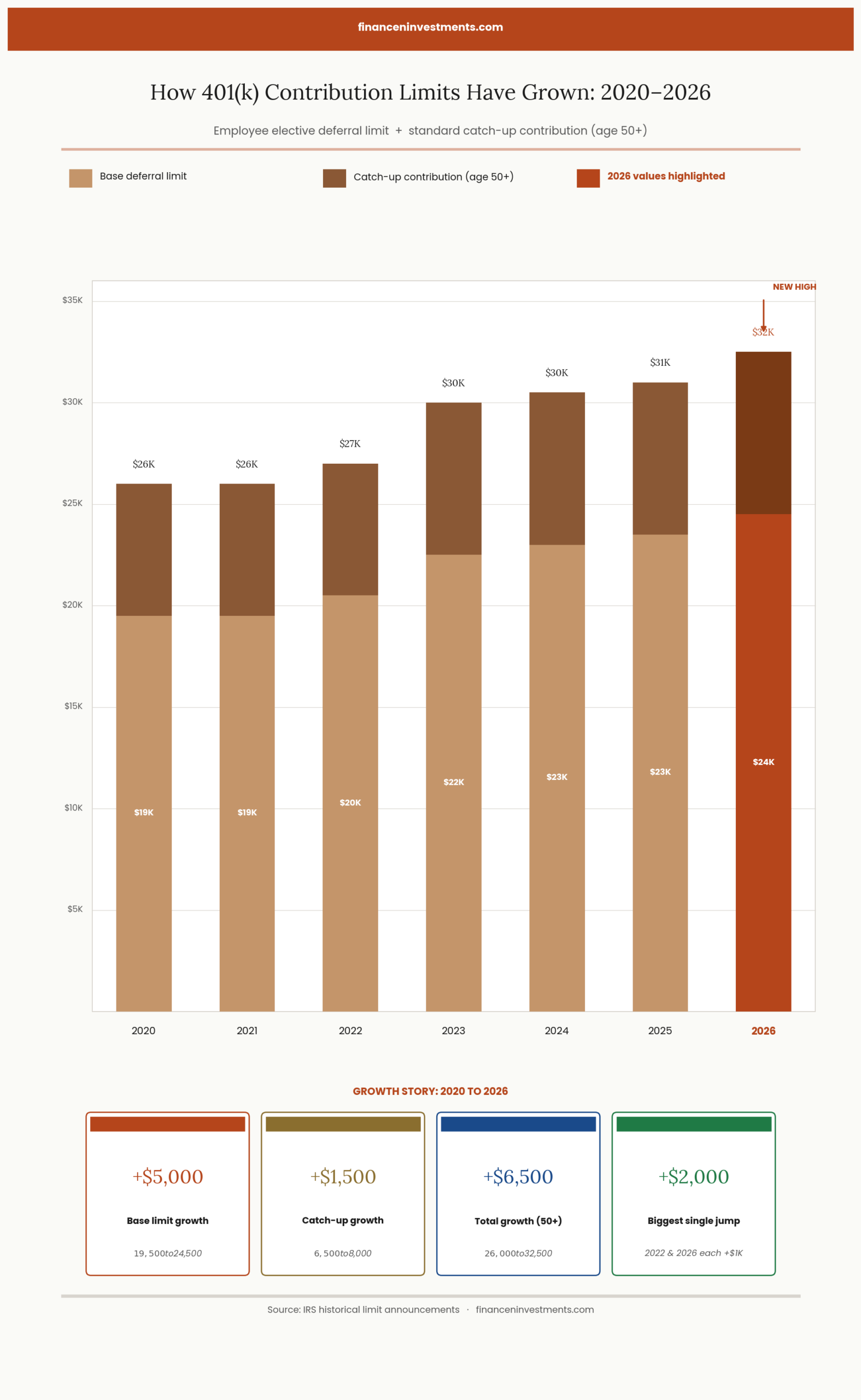
The first ceiling is the employee elective deferral limit – the amount you personally contribute from your paycheck, whether pre-tax (traditional) or after-tax (Roth). For 2026, that figure is $24,500. This is the number most people know and the one that the IRS raises via its annual cost-of-living adjustment process, tying adjustments to the CPI-W in $500 or $1,000 increments.
The second ceiling is the total annual additions limit under Section 415(c) – the grand sum of employee deferrals, employer contributions (matching, profit-sharing, non-elective), and any after-tax contributions your plan permits. For 2026, that ceiling is $72,000, or 100% of your compensation, whichever is lower. This is the number that matters for high-income earners, solo 401(k) holders, and anyone executing a mega backdoor Roth.
The third ceiling is the compensation limit – the maximum salary the plan can use when calculating employer contributions. For 2026, that cap is $360,000. If your employer matches 5% of your salary and you earn $400,000, their contribution is still calculated against $360,000.
Behavioral research consistently shows that most participants treat the employee deferral limit as the only number that matters. That framing leaves the $72,000 total cap almost entirely unconsidered, which is precisely where advanced strategies like the mega backdoor Roth live.
$24,500Employee deferral limit 2026
$72,000Combined employer + employee cap 2026
$35,750Max if aged 60–63 with super catch-up
$360,000Compensation limit for plan calculations
The 2026 401k Contribution Limits: Every Number in One Place
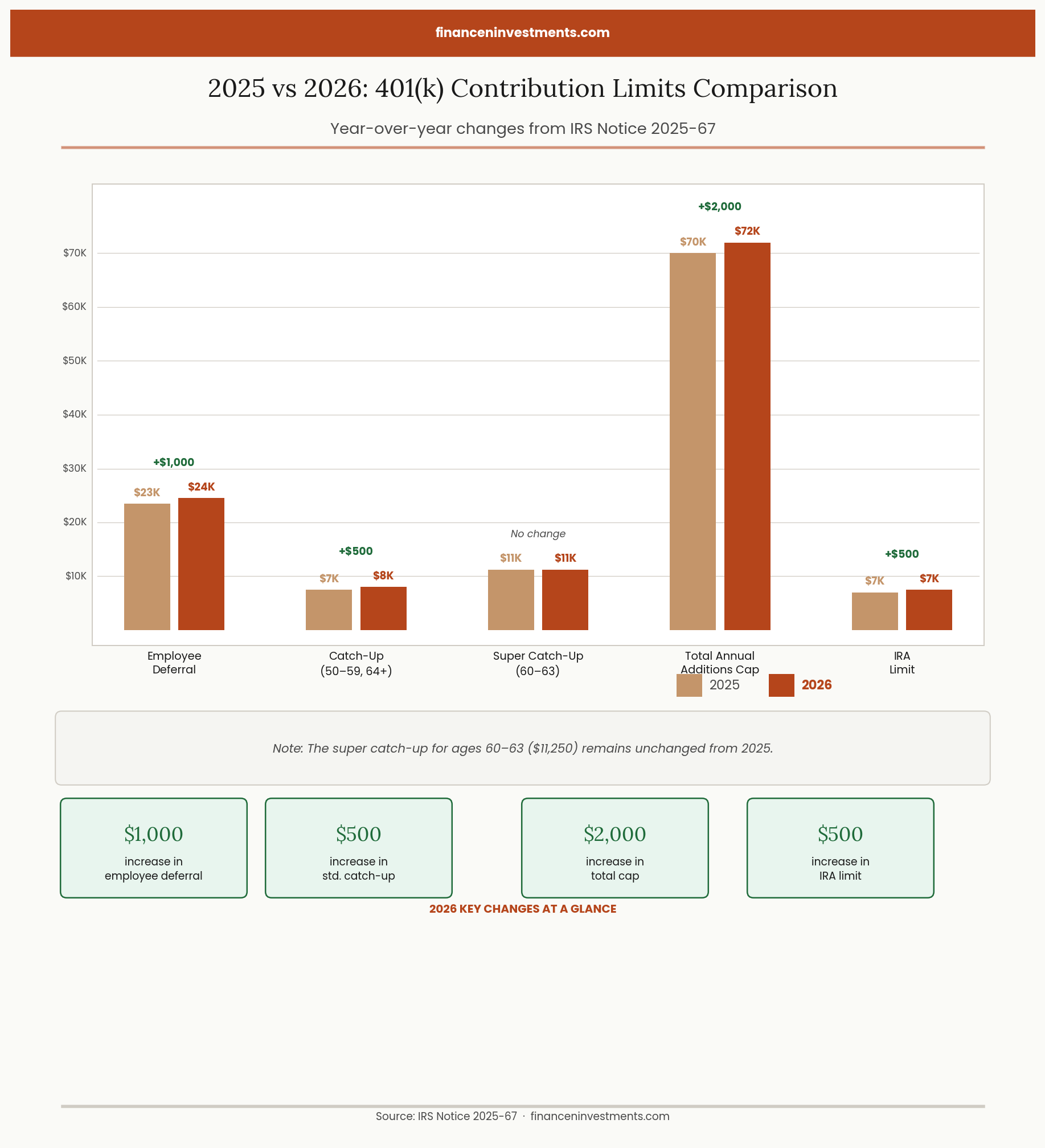
The table below consolidates IRS Notice 2025-67, released November 13, 2025, showing 2025 versus 2026 figures and the dollar change for each category.
| Limit Category | 2025 | 2026 | Change |
|---|---|---|---|
| Employee elective deferral (under 50) | $23,500 | $24,500 | +$1,000 |
| Catch-up contribution (ages 50–59 and 64+) | $7,500 | $8,000 | +$500 |
| Total deferral if aged 50–59 or 64+ | $31,000 | $32,500 | +$1,500 |
| Super catch-up (ages 60–63 only) | $11,250 | $11,250 | unchanged |
| Total deferral if aged 60–63 | $34,750 | $35,750 | +$1,000 |
| Total annual additions limit (Section 415) | $70,000 | $72,000 | +$2,000 |
| Total limit (age 50–59 or 64+, including catch-up) | $77,500 | $80,000 | +$2,500 |
| Total limit (age 60–63, super catch-up) | $81,250 | $83,250 | +$2,000 |
| Compensation limit for plan calculations | $350,000 | $360,000 | +$10,000 |
| IRA contribution limit (traditional + Roth combined) | $7,000 | $7,500 | +$500 |
| IRA catch-up (age 50+) | $1,000 | $1,100 | +$100 |
Source: IRS Notice 2025-67, November 13, 2025. All figures apply to traditional 401(k), Roth 401(k), 403(b), governmental 457 plans, and the federal Thrift Savings Plan.
Catch-Up Contributions: The Three-Tier Architecture
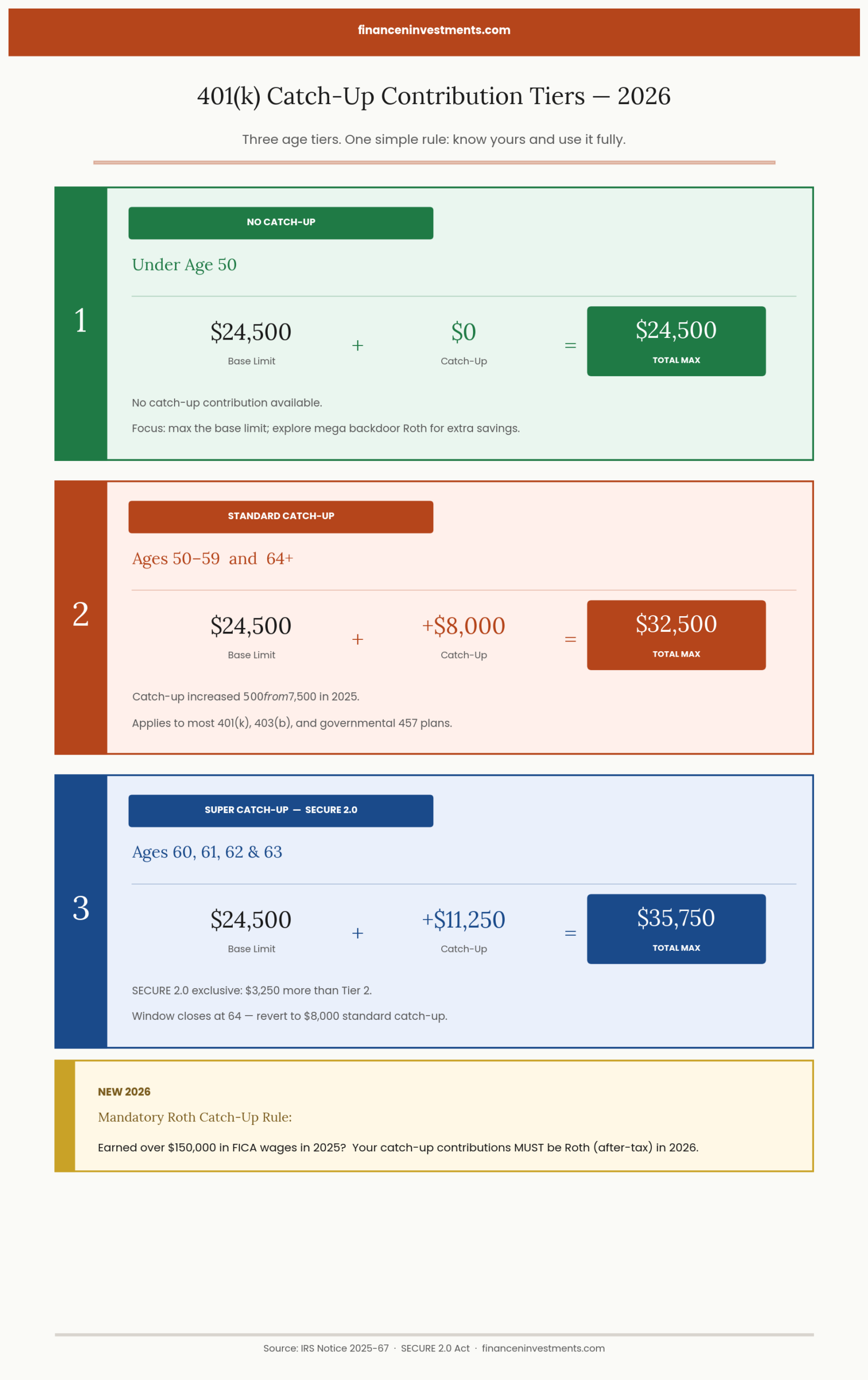
SECURE 2.0 – signed into law in December 2022 – restructured catch-up contributions into three distinct tiers. Understanding which tier applies to you is not a minor administrative detail; the gap between a standard catch-up and a super catch-up is $3,250 per year, which, at 7% over 10 years, grows to roughly $45,000.
Tier 1: Under age 50
No catch-up contribution is available. The maximum employee deferral is $24,500 for 2026. Your focus belongs on maximizing the base limit and pursuing any available after-tax contribution space for the mega backdoor Roth.
Tier 2: Ages 50–59 and 64 and older
Standard catch-up of $8,000 applies in 2026, up from $7,500 in 2025. Combined employee maximum: $32,500. This is the most common catch-up scenario and applies to the majority of near-retirement workers.
Tier 3: Ages 60–63 (the SECURE 2.0 super catch-up)
This is the most consequential change SECURE 2.0 introduced for late-career savers. Workers aged exactly 60, 61, 62, or 63 may contribute up to $11,250 as a catch-up, replacing – not stacking on top of – the standard $8,000 catch-up. Combined maximum: $35,750 in 2026.
New for 2026
Starting January 1, 2026, if you earned more than $150,000 in FICA wages from the plan sponsor in 2025, your catch-up contributions must be made as designated Roth contributions. Pre-tax catch-up contributions are no longer permitted for high earners. This mandatory Roth rule applies regardless of your age. Verify your employer’s payroll system is configured correctly before the year begins – plan administrators who miss this requirement face IRS correction procedures.
Employer Match: The Number That Doesn’t Count (Until It Does)
A persistent misconception is that employer matching contributions reduce the amount you can personally defer. They do not. Your employer’s contributions – whether a dollar-for-dollar match, a percentage match, or discretionary profit-sharing – are entirely separate from your $24,500 employee limit.
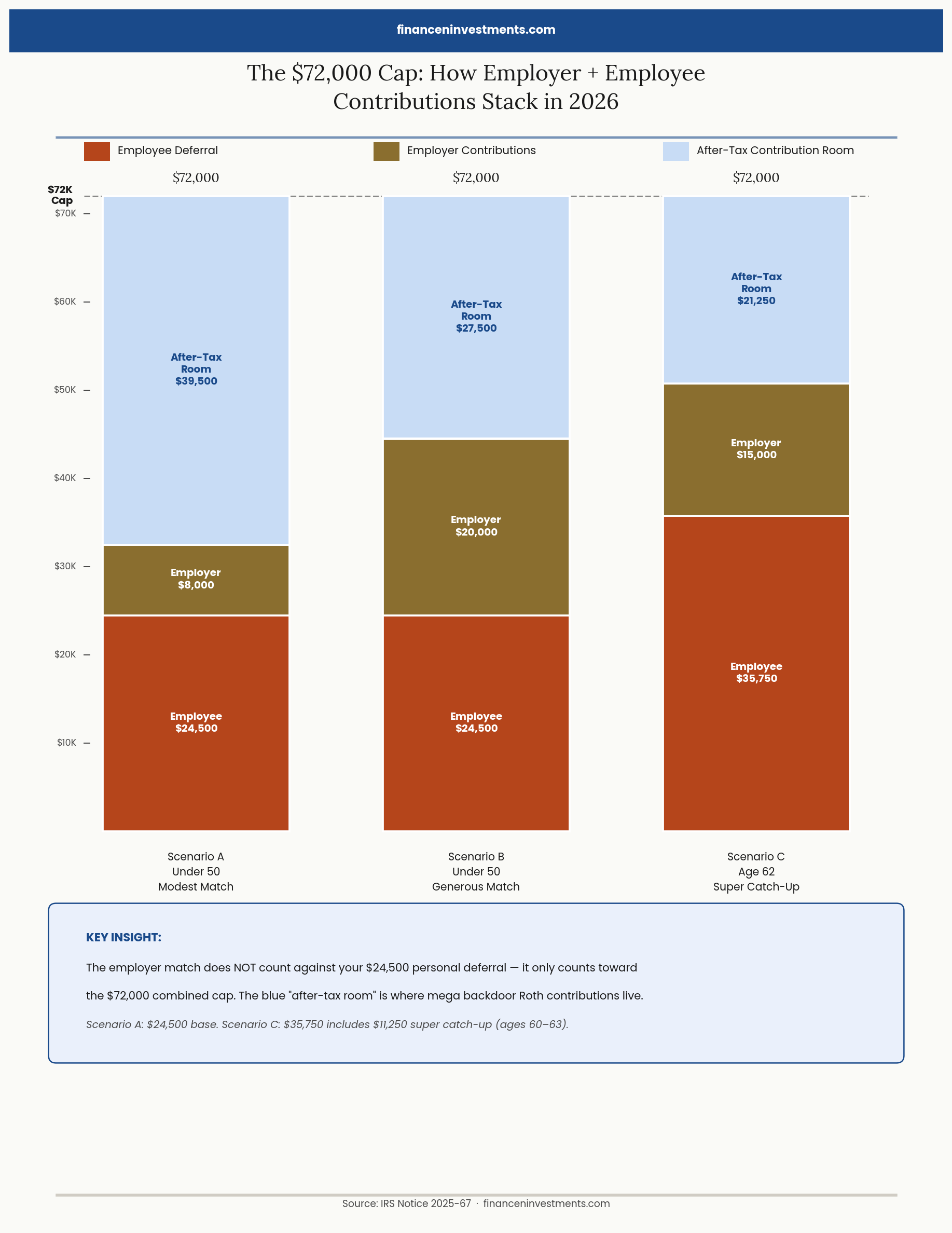
What employer contributions do affect is the $72,000 combined ceiling under Section 415. Consider a straightforward example: you contribute $24,500 (the employee maximum), and your employer contributes $15,000 (a generous match plus profit-sharing). The combined total is $39,500 – well inside the $72,000 limit, leaving $32,500 of room. That remaining room is the space where after-tax contributions – the engine of the mega backdoor Roth – can operate.
The employer match is free money. Capturing it is the highest-return guaranteed investment available to most workers – a 50% or 100% immediate return, depending on the match formula, before a single dollar of market return applies.
One nuance worth understanding: if your employer uses a “true-up” formula – calculating the full-year match at year end rather than per-pay-period – front-loading contributions early in the year may cause you to miss some matching dollars mid-year. Confirm whether your plan uses per-pay-period matching or an annual true-up before adjusting your contribution schedule.
The Mega Backdoor Roth: Using the Full $72,000 Limit
The mega backdoor Roth is the most powerful tax-advantaged strategy available to investors whose plans support it – yet a 2024 Vanguard survey suggested fewer than 10% of eligible workers are aware it exists.
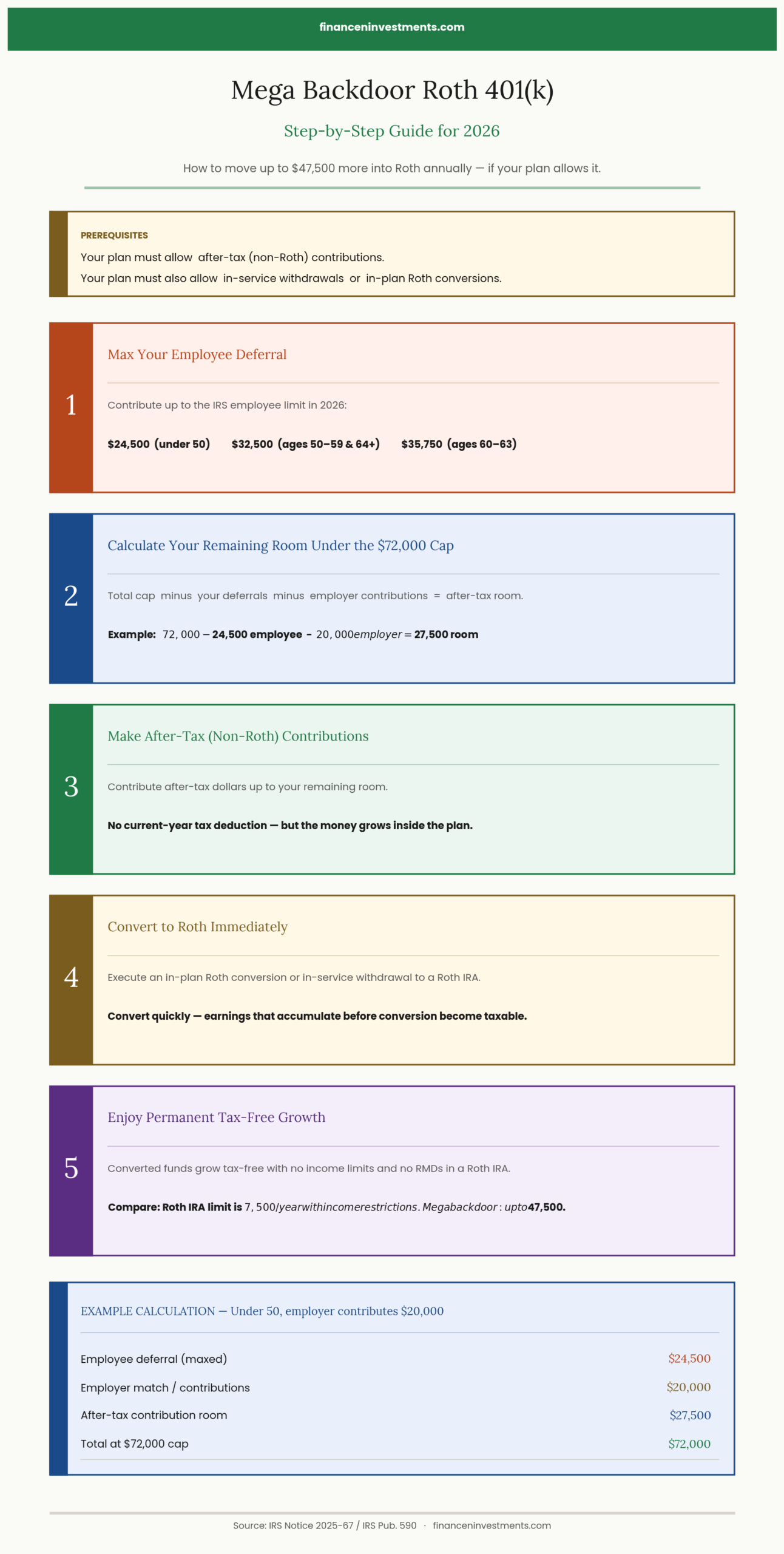
The mechanics require two conditions: your plan must permit after-tax (non-Roth) contributions and allow either in-service withdrawals or in-plan Roth conversions. When both are available, the strategy works as follows.
- 1. Max your employee deferral to $24,500 (or $32,500–$35,750 if eligible for catch-up contributions).
- 2. Calculate your remaining room under the $72,000 total cap: subtract your own deferrals and all employer contributions from $72,000.
- 3. Contribute after-tax (non-Roth) dollars up to that remaining amount. These contributions receive no current-year tax deduction but grow tax-deferred.
- 4. Immediately execute an in-plan Roth conversion or in-service withdrawal to a Roth IRA. Converting quickly minimizes the taxable earnings that accumulate on an after-tax basis, keeping the tax cost near zero.
- 5. Once inside a Roth vehicle, the converted funds grow permanently tax-free with no required minimum distributions.
For a worker under 50 whose employer contributes $20,000, the after-tax contribution room is $72,000 − $24,500 − $20,000 = $27,500. That $27,500 converted to Roth – combined with the base $24,500 deferral – produces $52,000 in a single year flowing toward tax-free retirement accounts. Compare that to the $7,500 Roth IRA limit (with income restrictions), and the advantage becomes obvious.
| Scenario (2026) | Employee Deferral | Employer Contribution | After-Tax Room | Total Cap Used |
|---|---|---|---|---|
| Under 50, generous employer match | $24,500 | $20,000 | $27,500 | $72,000 |
| Under 50, modest employer match | $24,500 | $8,000 | $39,500 | $72,000 |
| Age 62, super catch-up eligible | $35,750 | $15,000 | $21,250 | $72,000 |
| Solo 401(k) owner-only | $24,500 | up to $47,500* | up to $47,500* | $72,000 |
*Solo 401(k) employer contributions limited to 25% of W-2 wages (S-corp) or ~20% of net self-employment income (sole proprietor). Plan-specific and compensation-dependent.
Why Smart Investors Struggle with 401(k) Optimization
Three failure modes account for most of the value lost at the 401(k) contribution decision:
Anchoring to a percentage, not a dollar maximum. Setting contributions to a fixed percentage of salary feels systematic, but it routinely falls short of the IRS maximum for mid-to-high earners. A 10% deferral on a $180,000 salary produces $18,000 – $6,500 below the 2026 ceiling, and over 20 years at 7%, that gap compounds to over $265,000 in forgone tax-advantaged growth.
Ignoring the match true-up risk. Front-loading aggressively is mathematically attractive for time-in-market reasons, but if your plan calculates the match per paycheck rather than annually, you may stop receiving match dollars after hitting the limit in July. Verify the formula before optimizing the schedule.
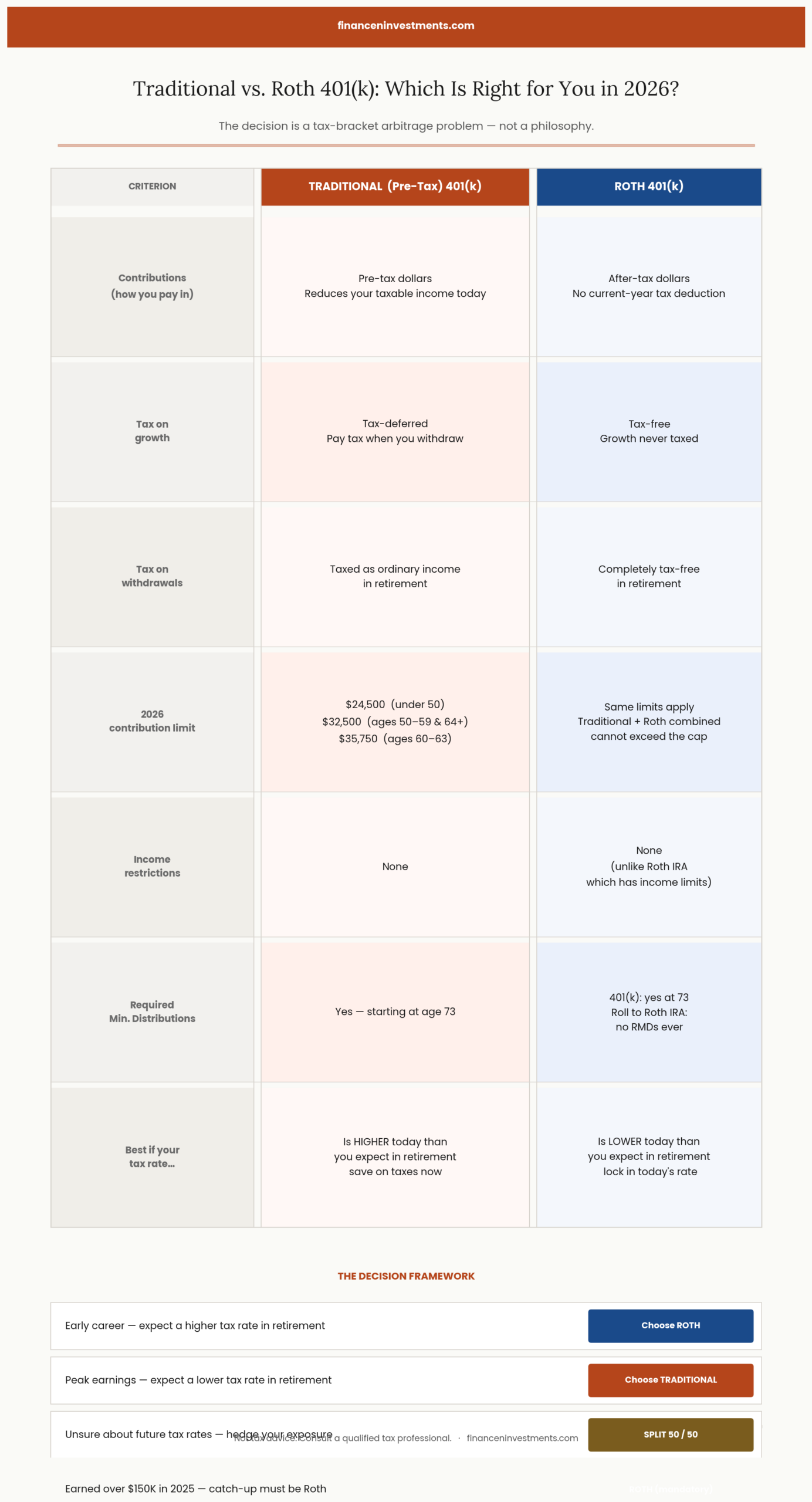
Treating Roth and traditional as arbitrary rather than strategic. The choice between pre-tax and Roth deferral is a tax-bracket arbitrage decision. If your current marginal rate is lower than your expected retirement rate – a reasonable assumption if you are early-career or expect significant Social Security income – Roth is superior. If your current rate is higher, traditional pre-tax deferral wins. This is not a philosophy; it is present-value arithmetic.
Step-by-Step Framework for 401(k) Optimization in 2026
- 1 Confirm your age tier. Identify whether you are under 50, 50–59, 60–63, or 64+. This determines your applicable contribution ceiling and whether the mandatory Roth catch-up rule applies to you.
- 2 Check your 2025 FICA wages. If you earned more than $150,000 from the same employer in 2025, your 2026 catch-up contributions must be designated as Roth. Contact your HR benefits team to confirm the plan’s payroll configuration.
- 3 Set contributions to hit the ceiling by December 31, not before. Unless your plan offers an annual true-up, spreading deferrals evenly across all pay periods ensures you capture every available matching dollar throughout the year.
- 4 Calculate your Section 415 remaining room. Subtract your planned deferrals and your estimated employer contributions from $72,000. If the difference is positive and your plan permits after-tax contributions, investigate the mega backdoor Roth.
- 5 Execute the Roth conversion promptly. After-tax contributions held inside the plan accrue earnings that become taxable upon conversion. Converting within days of each contribution minimizes this drag.
- 6 Layer in an IRA contribution. The $7,500 IRA limit (with $1,100 catch-up for age 50+) is separate from your 401(k) ceiling. Roth IRA income limits phase out between $153,000–$168,000 (single) and $242,000–$252,000 (married filing jointly). Above those thresholds, the backdoor Roth IRA conversion remains available.
- 7 Revisit annually. The IRS adjusts limits each November, effective January 1. Build a recurring calendar reminder for November to review the new figures and adjust your payroll elections before year-end.
The Future of 401k Contribution Limits: What’s Coming Next
The 2026 increases reflect inflation data from 2025, feeding the IRS’s CPI-W adjustment formula. If inflation moderates toward the Fed’s 2% target, future annual adjustments are likely to return to the $500 increment pattern seen in 2024–2025, rather than the $1,000 jump now in effect. However, the structural changes introduced by SECURE 2.0 remain: the super catch-up for ages 60–63 and the mandatory Roth catch-up for high earners are permanent fixtures, not temporary provisions.
SECURE 3.0 discussions in Congress have included proposals to further expand catch-up limits, introduce automatic escalation requirements for employer plans, and potentially reduce IRA income thresholds that currently allow higher earners to circumvent Roth IRA limits. Investors relying on backdoor strategies should monitor legislative developments.
On the technology front, plan providers including Fidelity, Vanguard, and Schwab have accelerated in-plan Roth conversion automation. What once required manual paperwork and multi-week processing windows now executes in days or hours on modern platforms, materially reducing the operational drag of mega backdoor strategies.
401k Contribution Limits 2026: Your Most Important Questions Answered
Q1. Does my employer’s match count toward the $24,500 employee contribution limit?
No. Employer contributions – matching, profit-sharing, or non-elective – are entirely separate from your $24,500 personal deferral ceiling. They do count toward the $72,000 combined annual additions limit under Section 415(c). The two ceilings operate independently.
Q2. Can I contribute to both a traditional and a Roth 401(k) in the same year?
Yes, and many plans permit this split. However, your combined contributions across traditional and Roth 401(k) accounts cannot exceed $24,500 (or the applicable higher limit if you are eligible for catch-up contributions). There are no income restrictions on Roth 401(k) contributions, unlike Roth IRAs.
Q3. What happens if I over-contribute to my 401(k)?
Excess deferrals are taxable in the year contributed and taxable again upon distribution – you pay tax twice. You must notify your plan administrator and withdraw the excess plus attributable earnings before April 15 of the following year to avoid the double-tax outcome. Most modern payroll systems cap contributions automatically, but switching jobs mid-year creates the greatest risk of unintentional over-contribution across two separate plans.
Q4. My employer has no Roth 401(k) option. Can I still access Roth treatment in my plan?
Potentially, through after-tax contributions and in-plan Roth conversions – the mega backdoor Roth path. The availability depends on whether your plan document permits after-tax (non-Roth) contributions and in-plan conversions, which are plan-specific. Check with your HR or benefits administrator, as these features are not universally offered.
Q5. How does the mandatory Roth catch-up rule work in 2026?
If you earned more than $150,000 in FICA wages from your current employer in 2025, your 2026 catch-up contributions to that employer’s plan must be designated as Roth (after-tax). This applies regardless of age and was originally scheduled for 2024, but was delayed. Workers below the $150,000 threshold can still choose pre-tax or Roth catch-up.
Q6. What is the super catch-up, and who qualifies for it?
The super catch-up, introduced by SECURE 2.0, allows workers aged exactly 60, 61, 62, or 63 to contribute $11,250 as a catch-up instead of the standard $8,000 in 2026. It is not additive – you choose one or the other. The window is narrow by design: once you reach 64, you revert to the standard $8,000 catch-up limit.
Q7. Can I contribute to a 401(k) and an IRA in the same year?
Yes. The 401k contribution limits and IRA limits are entirely separate. For 2026, the IRA limit is $7,500 ($8,600 with catch-up for age 50+). Traditional IRA deductibility phases out if you (or your spouse) are covered by a workplace plan and your income exceeds certain thresholds. Roth IRA contributions phase out between $153,000–$168,000 for single filers and $242,000–$252,000 for joint filers. Above those thresholds, the backdoor Roth IRA conversion remains available.
Q8. What does it cost to not max out my 401(k)?
An investor who contributes $19,500 per year instead of $24,500 leaves $5,000 annually out of a tax-advantaged wrapper. At a 7% return over 25 years, that $5,000 annual shortfall represents approximately $317,000 in forgone growth – before accounting for the tax savings on pre-tax deferrals. The compounding cost of under-contribution is not front-loaded; it is back-loaded, appearing most painfully in the final years of a career when accounts are largest.
Q9. Is there a minimum contribution required to receive employer matching?
There is no IRS-mandated minimum, but each employer defines its own match formula. Common structures require you to contribute at least 3–6% of your salary to receive the full match. Failing to meet that threshold forfeits free compensation – consistently the highest-priority retirement action before any other optimization. Always capture the full employer match first.
Q10. Are there contribution limits for a solo 401(k) if I am self-employed?
Solo 401(k) owners contribute in two capacities: as an employee (up to $24,500 in 2026, plus catch-up if eligible) and as an employer (up to 25% of W-2 wages for S-corps, or approximately 20% of net self-employment income for sole proprietors). The combined cap is $72,000 – the same Section 415 ceiling that applies to all plans. Self-employed individuals with high income can often reach the full $72,000, making the solo 401(k) one of the highest-capacity tax-advantaged vehicles available.
Conclusion: The Architecture Rewards Those Who Study It
The 2026 401k contribution limits represent the most generous tax-advantaged savings window in recent history – $24,500 in employee deferrals, $8,000 in standard catch-ups, $11,250 for the 60–63 super catch-up, and up to $72,000 in total annual contributions. None of that potential converts to wealth automatically. It requires deliberate elections, careful awareness of the mandatory Roth catch-up rule for high earners, and an understanding of the gap between the employee ceiling and the total annual additions cap, where after-tax and mega backdoor strategies operate.
The compounding mathematics are not forgiving of delay. Every year spent at a suboptimal contribution rate is not merely a missed saving opportunity – it is a permanently smaller number earning returns for the following thirty years. Review your plan elections now, confirm your age tier, check your 2025 FICA wages against the $150,000 Roth catch-up threshold, and contact your plan administrator to explore the availability of after-tax contributions. The architecture is in place. The window opens on January 1.
Good luck with your future investments!
Didi Somm & Team
Recently published articles include:
- BACKDOOR ROTH IRA – All You Need To Know in 2026
- Roth IRA Guide: Your Roadmap to Tax-Free Retirement Wealth
- The 3-Fund Portfolio: A Complete Guide to Simple, Powerful Investing
- Value vs Growth Investing: Which Strategy Wins in 2026?
- Active vs Passive Investing – Your Best Guide
- Expense Ratios: Why Fees Matter
- Dollar-Cost Averaging Explained: The Simple Strategy That Removes Emotion from Investing
- What Are Dividend Stocks – The Ultimate Income Guide
Disclaimer: This article is for informational and educational purposes only and does not constitute personalized tax, legal, or investment advice. Contribution limits and rules are based on IRS Notice 2025-67 and SECURE 2.0 provisions as understood at the time of publication. Individual circumstances vary. Consult a qualified tax professional or financial advisor before making contribution decisions.